- September 28, 2026
- 0 comments
- 11 Views
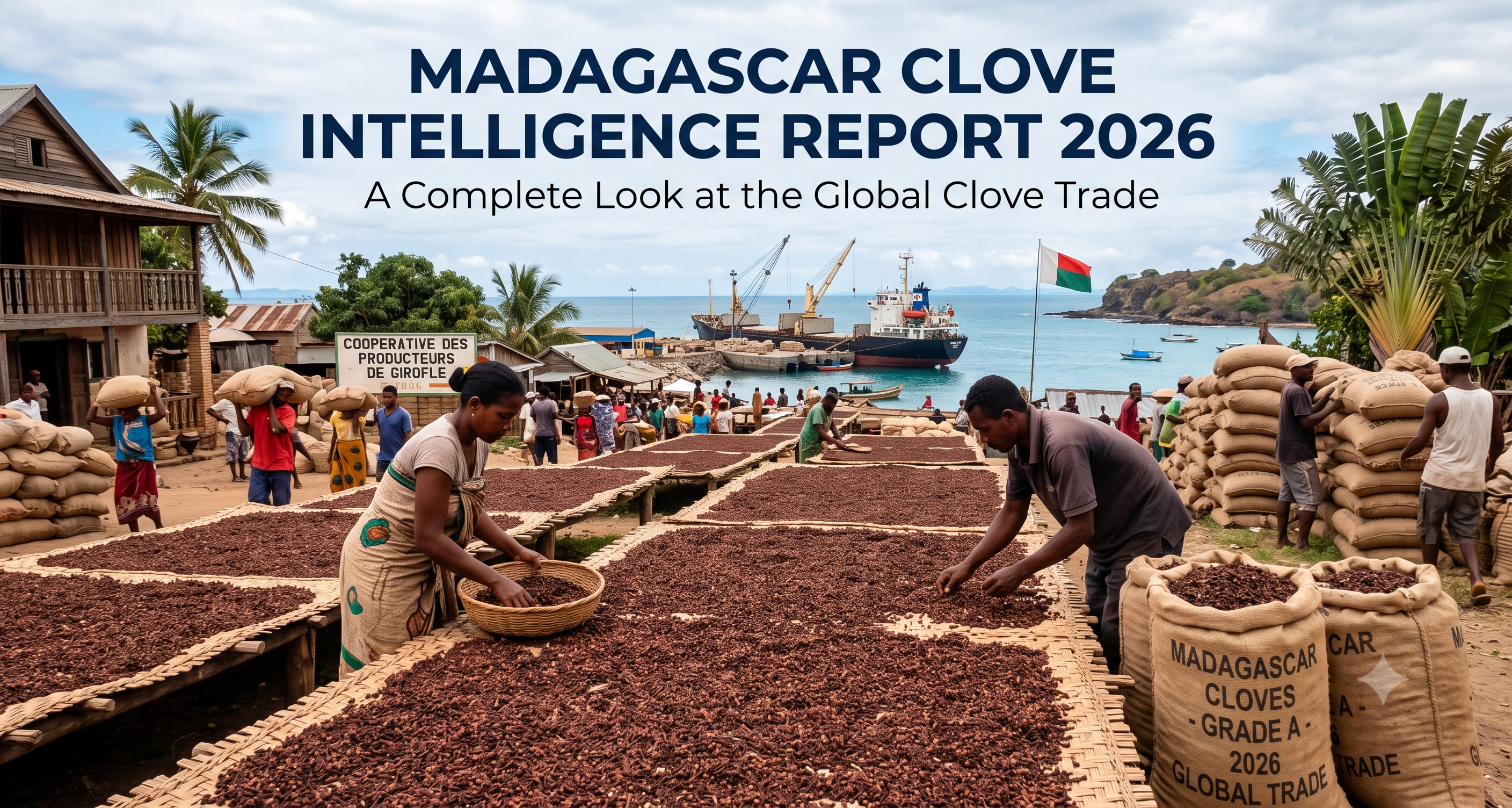
CLOVE
Intelligence Report 2026
Plantation mapping, production intelligence, market timing and risk analysis for the global clove trade.
What This Edition Is — And What It Is Not
Basic Intelligence gives the reader the market frame: the physical scale of Madagascar's mapped clove system, the timing of supply, global context, destination visibility and the principal commercial risks.
| Evidence layer | What it means |
|---|---|
| Mapped result | Satellite-derived plantation estimate validated against field evidence. |
| Modelled production | Mapped maturity area translated into a production benchmark using regional/class yield logic. |
| Public trade data | Customs-reported HS 0907 flows used for market structure and destination analysis. |
| Field evidence | Ground observations used to validate crop condition, plantation characteristics and commercial interpretation. |
| Expert interpretation | A commercial conclusion drawn from multiple evidence layers — not a deterministic forecast. |
Who Should Use Basic Intelligence — And For What?
The same crop number means different things to different decision makers. Use this edition as an orientation tool before moving into detailed commercial planning.
| User | Primary decision | Use this edition to... |
|---|---|---|
| Trader | Origin positioning | Compare Madagascar with competing origins and monitor supply concentration, destination demand and execution risk. |
| Importer | Coverage timing | Understand crop windows, destination breadth and quality/logistics risk before committing coverage. |
| Food manufacturer | Supply continuity | Translate crop, drying and logistics risks into procurement and specification planning. |
| Processor / exporter | Origin execution | Assess crop geography, season timing, access constraints and the scale of the national supply base. |
| Financial / insurance user | Exposure screening | Identify concentration, weather, currency, policy and logistics variables that can affect execution. |
Madagascar Clove Intelligence Dashboard
Six metrics establish the physical scale, confidence and concentration of the mapped clove system.
The mapped core covers four primary east-coast regions. Analanjirofo alone accounts for approximately 78% of mapped area, making national availability highly sensitive to conditions in one region.
Five Findings That Change The Commercial View
| # | Finding | Commercial meaning |
|---|---|---|
| 1 | Supply is concentrated | Analanjirofo dominates both mapped area and modelled output; national supply cannot be read as geographically diversified. |
| 2 | Maturity matters more than hectares alone | The productive value of plantation area depends on maturity class and region-specific performance. |
| 3 | 28,878 tonnes is a production benchmark — not export availability | Stocks, moisture/process loss, farmer behaviour, licensing and market timing separate biological output from customs exports. |
| 4 | Indonesia remains the largest external swing variable | A weak Indonesian crop can increase Madagascar demand rapidly, but inventory, policy and kretek demand also matter. |
| 5 | Execution risk can matter before statistics show it | Harvest-stage rain, FX, roads, documentation and port performance can change the trade outcome after the crop is already counted. |
Executive Market View
Madagascar is highly export-oriented, but crop size, export availability and market realization are three different questions.
| Crop | Market | Execution |
|---|---|---|
| The survey mapped 126,600 ha and modelled 28,878 tonnes of dry-clove output. | Madagascar competes within a concentrated global clove system shaped by Indonesia, India and a long tail of destination markets. | Drying quality, FX, licensing, logistics and political continuity determine how much biological output becomes financeable export supply. |
Commercially, the most important distinction is between a plantation-derived production benchmark and the quantity that is actually offered, processed, financed and shipped. Harvest timing, farmer liquidity, leaf harvesting for essential oil, weather and post-harvest losses all influence the gap.
- For buyers: plan coverage before origin procurement accelerates and before external demand becomes visible at origin.
- For sellers: nominal origin availability is not the same as realized margin; execution costs and risk continue after procurement.
- For financial users: concentration, weather and policy continuity can matter as much as the national crop estimate.
Madagascar in the Global Clove Market
Madagascar cannot be analysed in isolation: Indonesia is simultaneously the largest structural producer and consumer, while other origins create alternative supply and pricing references.
- Indonesia is the global system's dominant supply-and-demand variable.
- Madagascar is highly export-oriented and therefore especially exposed to shifts in destination demand.
- Tanzania/Zanzibar, Sri Lanka, Comoros and Brazil remain smaller but commercially relevant alternative origins.
- Madagascar's reported 2022–2023 customs anomaly should be reconciled with physical crop evidence rather than used as a standalone production proxy.
Crop Calendar & Supply Timing
The South opens the season earlier; the North supplies the principal volume. Procurement, drying and shipment should therefore be read as a sequence rather than a single harvest date.
| Commercial stage | Typical timing | What changes commercially |
|---|---|---|
| Vegetative recovery / bud formation | Feb–May | Weather conditions influence crop development well before harvest. |
| Flowering & bud development | May–Aug | Monitoring begins to matter as potential supply becomes visible. |
| South harvest | Aug–Oct | Earlier crop appears; quality and drying conditions become critical. |
| North harvest | Oct–Dec | Largest-volume window; procurement competition generally intensifies. |
| Cleaning / drying / packing | Sep–Jan | Process loss, moisture management and specification risk affect exportability. |
| Shipment / inventory decisions | From season opening onward | Timing depends on buyer demand, finance, documentation and port execution. |
Weather has opposite commercial effects at different crop stages: moisture supports crop development, but rain immediately after harvest can interrupt sun drying and damage colour and quality.
How The Crop Was Measured
The research programme combines repeated satellite observation with field validation rather than relying on either source alone.
- Multi-temporal Sentinel-2 imagery provides repeated, consistent observation across the study area.
- 1,370 recorded ground-control points support classification and validation; unsuitable points were removed through quality control.
- A separate 27-day field campaign in 2025 geotagged 70 clove plantations and recorded age, density, yield, intercrops, condition, post-harvest practice and farmer interviews.
- Physical yield observations link mapped maturity classes to the modelled production benchmark.
National Plantation & Production Benchmark
The mapped commercial clove belt is large, but the supply base is highly concentrated by region and maturity.
Where Madagascar Cloves Go
Company-level customs visibility varies by jurisdiction, so reporter-side country data provide a broader view of the markets reached by Madagascar-origin cloves.
Madagascar-reported 2024 data show a broad destination footprint across Asia, the Middle East, Europe, Africa and the Americas. India is the largest declared destination in this reporter-side series; Indonesia, Vietnam, China, Egypt, the Gulf, Europe, Russia and other markets also appear in the trade footprint.
Destination statistics should not automatically be interpreted as final consumption. Trading and redistribution hubs can appear as customs destinations even when cargo ultimately serves another market.
Commercial Risk Watch
The crop can remain physically available while trade execution deteriorates. Basic Intelligence therefore treats weather, demand, FX, politics and logistics as live decision variables.
- Weather: harvest-stage rain can damage drying quality after the biological crop is already counted.
- Demand: Indonesia and India can tighten origin quickly - or expose overstocked exporters by waiting.
- FX: Ariary strength can raise USD-equivalent procurement cost even if local prices appear unchanged.
- Execution: roads, documentation, port performance and policy continuity affect financeable shipment availability.
2026/27 Market Outlook
Rather than publish a single deterministic forecast, Basic Intelligence uses scenarios to show how crop, demand and execution shocks change the commercial response.
| Scenario | Configuration | Commercial reading |
|---|---|---|
| Tight balance | Weather damage + active Indonesia/India demand | Earlier buyer coverage; stronger origin competition; less room for delayed execution. |
| Base case | Normal crop + mixed demand + manageable execution | Selective procurement; market remains sensitive to demand timing and quality. |
| Supply heavy | Good crop + slower major-market demand | Buyers gain leverage; exporters need stronger discipline on stock, finance and quality. |
| Execution shock | Normal crop + political / FX / logistics disruption | Physical crop may exist but financeable, shippable availability can tighten suddenly. |
What to watch next: Analanjirofo weather, Indonesia crop and inventory signals, Indian enquiry intensity, harvest-stage drying conditions, Ariary direction, licensing continuity and logistics reliability.
You Have the Market Frame. Choose How Deep You Need to Go.
Basic Intelligence is designed to orient the reader. When the next decision involves procurement planning, capital, inventory, margin or counterparty exposure, the paid editions add progressively deeper decision support.
| Professional Intelligence | Premium Intelligence |
|---|---|
| For deeper commercial planning | For execution, margin and market-access decisions |
| Condensed methodology and field/satellite evidence | Everything in Professional, plus the complete evidence base and analytical depth |
| Full global market dynamics: Indonesia, India, origin competition and customs-data interpretation | Proprietary procurement and sales-realization intelligence |
| National plantation assessment: mapped area, maturity, production, rainfall, terrain and access | Export-ready cost, margin and seasonal spread analysis |
| Four condensed regional commercial profiles | Full regional plantation atlas and production construction by region and maturity |
| Full country-level destination intelligence | Top 50 identified buyers + Top 50 shippers/exporters of record |
| Expanded weather, FX, political, logistics and demand-risk analysis | Counterparty Intelligence workbook and market-access concentration analysis |
| Condensed scenario framework and commercial outlook | Trader Timing Playbook and deeper execution scenarios |
Choose Professional when you need to understand the crop and market in enough depth to plan coverage, sourcing, processing or risk exposure.
Choose Premium when the decision moves from planning to execution — when you need proprietary price/cost intelligence, named counterparties, margin timing and the full evidence trail behind the national crop model.