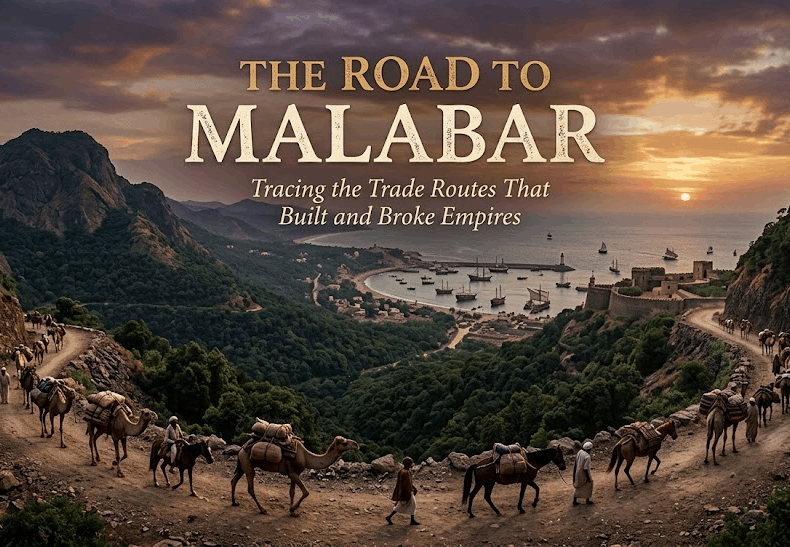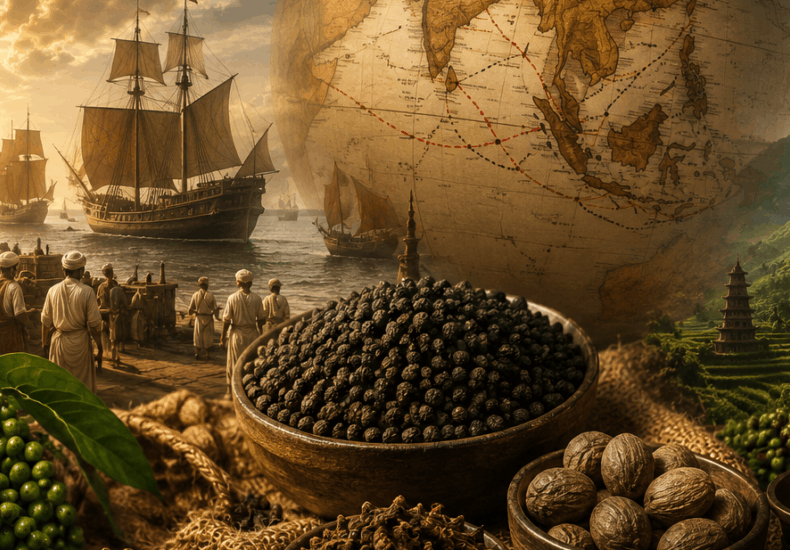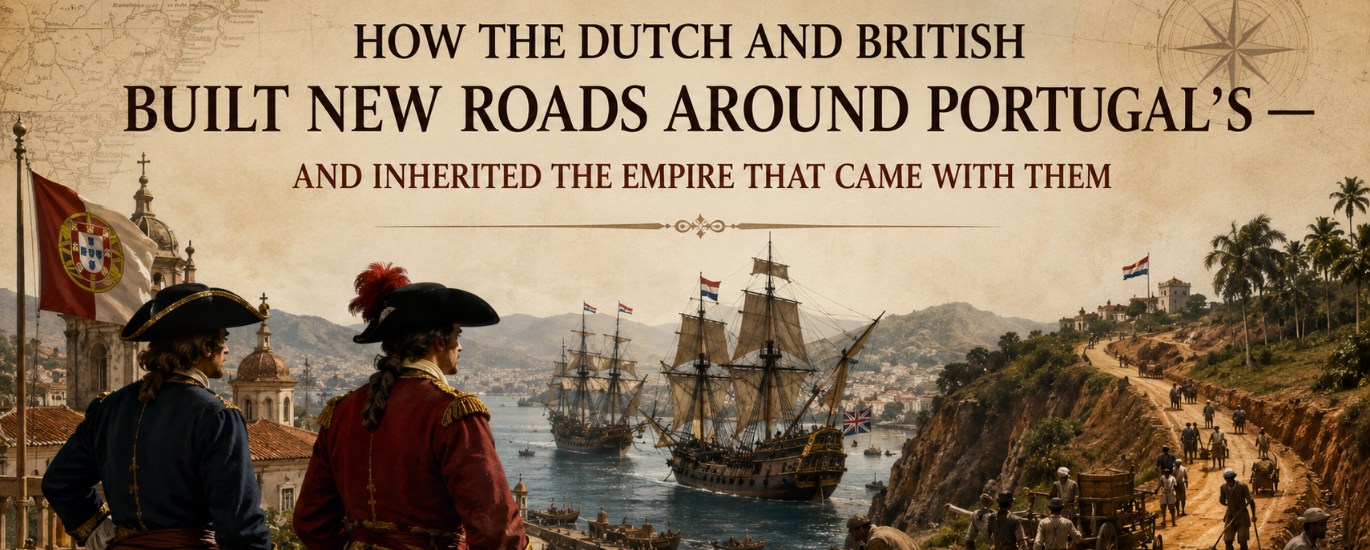
Portugal held the road for a century. That’s the sentence this story starts on, and it’s worth taking literally rather than as a figure of speech. For roughly a hundred years after Vasco da Gama’s landing at Kappad in 1498, Portugal controlled the sea lane connecting Europe to the spice-producing world — not through better trade relationships or better prices, but through fortresses, patrols, and the Cartaz licensing system that made every ship in the Indian Ocean pay for the privilege of sailing it. That arrangement worked exactly as long as no one else could build a competing road. And by the turn of the 17th century, two rival nations had decided they could.
This is the story of what happened next — how the Dutch and the British each built their own road around Portugal’s monopoly, and how, in doing so, they didn’t just capture a trade route. They inherited the entire logic of empire that Portugal had pioneered, and then took it much further.
Act One: The Cracks in a Century-Old Monopoly
By the late 1500s, Portugal’s Indian Ocean empire was showing the particular kind of weakness that comes from spreading a small population across an enormous amount of geography. Portugal was a country of roughly a million people trying to police an ocean that touched three continents. Its fortresses at Goa, Cochin, and elsewhere were real and defensible, but they were also few, and the sea lanes between them were long. The Cartaz system worked because Portugal had enough ships to make noncompliance dangerous — but it had never had enough ships to make the entire ocean truly closed. There was always a gap for a determined rival to slip through.
That gap became an opportunity the moment two things happened in Europe. First, Portugal itself came under Spanish rule in 1580, a dynastic union that folded the small, previously independent kingdom into the much larger Spanish crown for sixty years. This didn’t destroy Portugal’s Asian empire outright, but it did tangle Portuguese colonial interests up in Spain’s wars — including Spain’s long, expensive conflict with the rebellious Dutch provinces. Second, and directly as a consequence, Philip II of Spain closed the port of Lisbon to Dutch shipping in the 1590s, cutting off the intermediary role Dutch merchants had long played in redistributing Portuguese-imported spices across northern Europe.
This is worth pausing on, because it’s a near-exact replay of the pressure point from a century earlier. In 1453, the Ottoman capture of Constantinople and the Venetian grip on Mediterranean ports had priced Portugal out of the old overland spice road, and Portugal had responded by sailing around the entire problem. Now Portugal — or more precisely, the crown Portugal had been folded into — was doing the same thing to the Dutch. Cut off from buying spices secondhand in Lisbon, Dutch merchants faced the identical choice Portugal had faced in the 1480s: pay whatever the new middleman demanded, or go find the source directly. They chose the ocean.
Act Two: The Dutch Road Begins
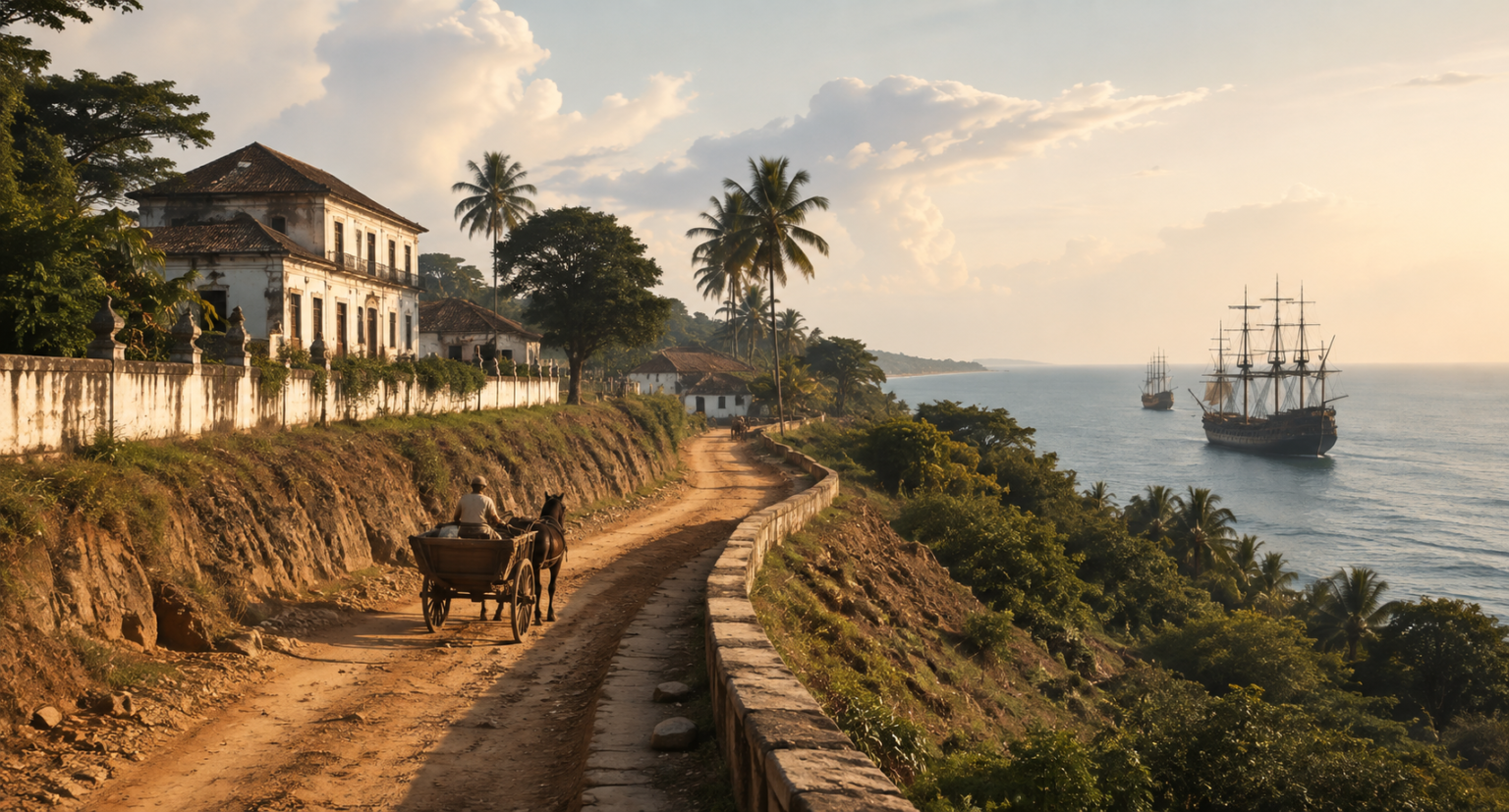
The first Dutch fleet reached the source in 1596, sailing directly for the Indonesian archipelago rather than trying to compete with Portugal in India. It was a modest financial success at best, bringing back a small cargo after a rough and costly voyage — but it proved the route was survivable, and that was enough. A second fleet did considerably better, and within a few years, a rush of competing Dutch trading companies had formed, all chasing the same spices, all bidding against each other and driving up the purchase price on the Asian end while flooding the market back home.
The fix came in 1602, when the Dutch government forced these competing companies to merge into a single entity: the Vereenigde Oost-Indische Compagnie, or VOC — the Dutch East India Company. This is arguably the most consequential organizational innovation in the entire story. The VOC wasn’t simply a trading firm with a royal blessing, the way Portugal’s crown-run system had been. It was chartered with the power to wage war, negotiate treaties, build fortresses, mint its own currency, and administer territory in the Dutch republic’s name, all while remaining, structurally, a company answerable to shareholders. It was granted a monopoly on all Dutch trade east of the Cape of Good Hope, and it moved into the Indian Ocean not as a supplicant looking for scraps of Portugal’s business, but as an organization explicitly built to displace Portugal outright.
Act Three: The Dutch Seize the Source
The VOC’s expansion happened with startling speed. Dutch ships had reached the Moluccas — the actual Spice Islands, source of nutmeg, mace, and cloves — as early as 1599, and found local rulers who were, in many cases, eager to trade with anyone willing to undercut Portuguese terms. By 1605, the VOC had captured Portugal’s forts at Ambon and Tidore, effectively ending Portuguese power in the Moluccas within just three years of the company’s founding. The VOC pushed its capital to Batavia, on Java, in 1619, giving it a central administrative base from which to run the entire eastern trade.
In 1621, it seized the Banda Islands, the world’s primary source of nutmeg, in a campaign brutal enough that much of the existing population was killed or deported to secure Dutch control of production outright. And in 1641, after a sustained blockade, Malacca — the strategic strait-side fortress the Portuguese had held since the early 1500s — finally fell to a combined Dutch and local Johor force, closing off one of the last major Portuguese positions in Southeast Asia.
What’s striking is how closely the Dutch method mirrored the Portuguese one, just executed with more capital and more ruthlessness. Portugal had used the Cartaz to force every independent trader to pay for passage. The VOC went further and simply eliminated independent producers where it could, monopolizing entire islands’ worth of nutmeg and clove production rather than merely taxing the ships that carried them. Where Portugal had built a toll road, the Dutch built something closer to a company-owned plantation system stapled onto a war fleet — the sea lane wasn’t just controlled, it was, in the most literal sense, industrialized.
Act Four: The British Choose a Different Road
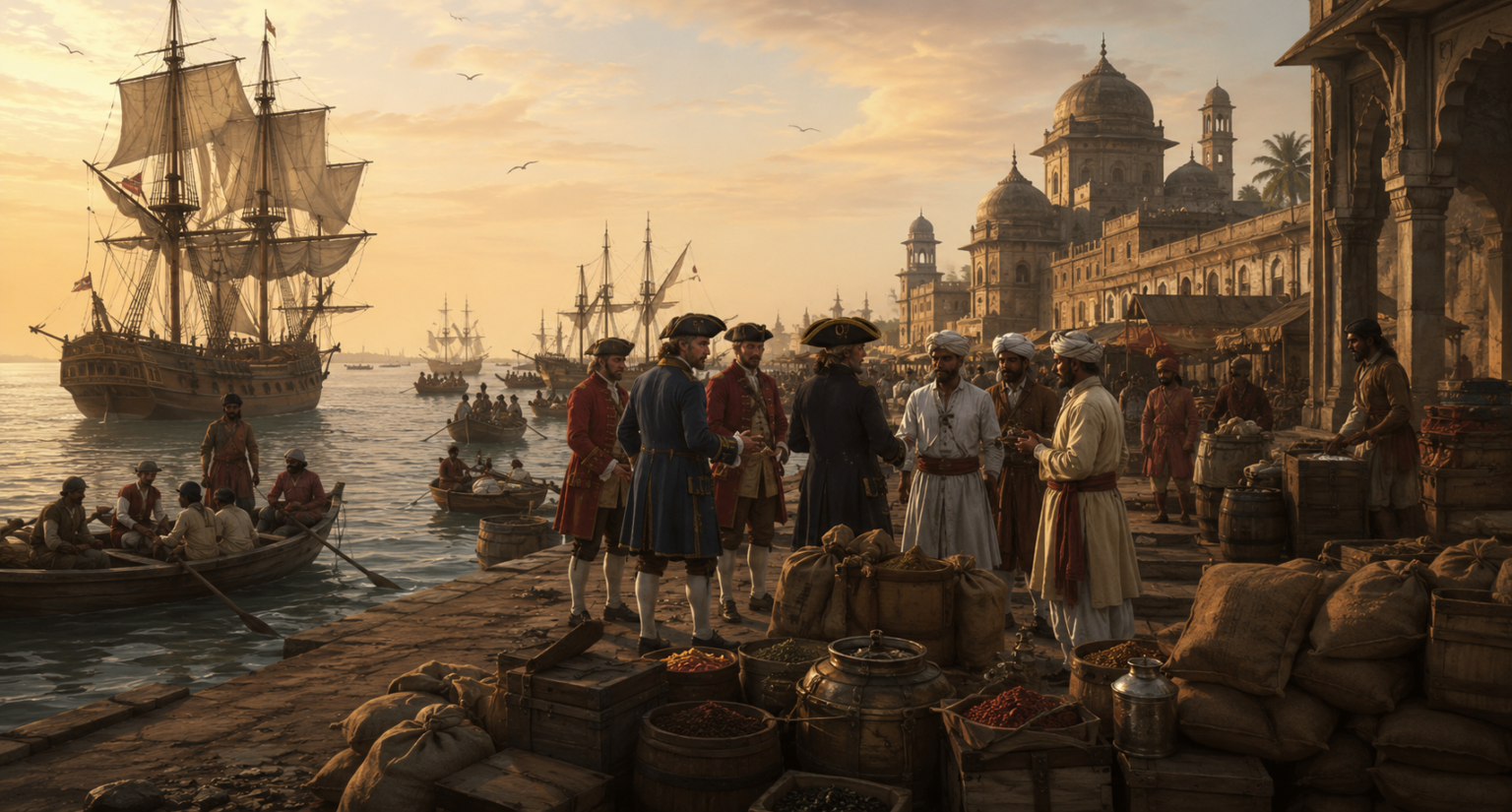
The English were moving at almost exactly the same time, chartered as the East India Company on the last day of December 1600 — slightly ahead of the VOC, though initially with a fraction of its capital and organizational muscle. And this is where the story bends in an important direction, because the British didn’t fight the Dutch for the same road. They built a different one.
The Dutch had gone straight for the Spice Islands, the literal source of nutmeg and cloves, and were prepared to fight brutally to hold that ground exclusively. The English, arriving with smaller fleets and less government backing, found themselves repeatedly outmuscled whenever they tried to compete for the same territory — a rivalry that came to a head in 1623, when Dutch forces executed a group of English traders at Ambon, effectively ending serious English ambitions in the Spice Islands for good. Rather than keep fighting a losing battle on Dutch terms, the English East India Company redirected its ambitions westward, toward the Indian subcontinent itself.
This turned out to be the more durable strategy. The English established their first factory at Surat, on India’s west coast, gaining trading rights from Mughal authorities in the early 1600s and formalizing them further after diplomatic missions to the Mughal court. From Surat, the Company expanded along both coasts of India, establishing further trading posts that would eventually grow into the three presidency towns of Bombay, Madras, and Calcutta — a coastal ring of factories that gave the English something the Dutch, focused on Indonesian islands, never quite prioritized: a foothold in the far larger and more populous Indian mainland itself.
Act Five: From Trading Post to Empire
For over a century, the English presence in India remained a trading relationship rather than a conquest — the Company operated at the pleasure of Mughal authority, negotiating for exemptions and privileges rather than dictating terms. That changed decisively in 1757, at the Battle of Plassey, where Company forces under Robert Clive defeated the Nawab of Bengal with the help of a defector within the Nawab’s own command.
Plassey is the hinge point where the English East India Company stopped being a trading operation that happened to carry weapons, and became a territorial power that happened to also trade. Within a decade, the Company held formal revenue-collecting rights over Bengal, Bihar, and Orissa — no longer a merchant guest of a sovereign power, but the sovereign power itself, at least for one of the richest provinces in the world. A second decisive victory at Buxar in 1764 extended that influence further, and over the following century, war, annexation, and alliance steadily brought most of the Indian subcontinent under Company control. What began as a coastal ring of trading posts had become the governing authority over tens of millions of people.
Act Six: Same Playbook, New Roads
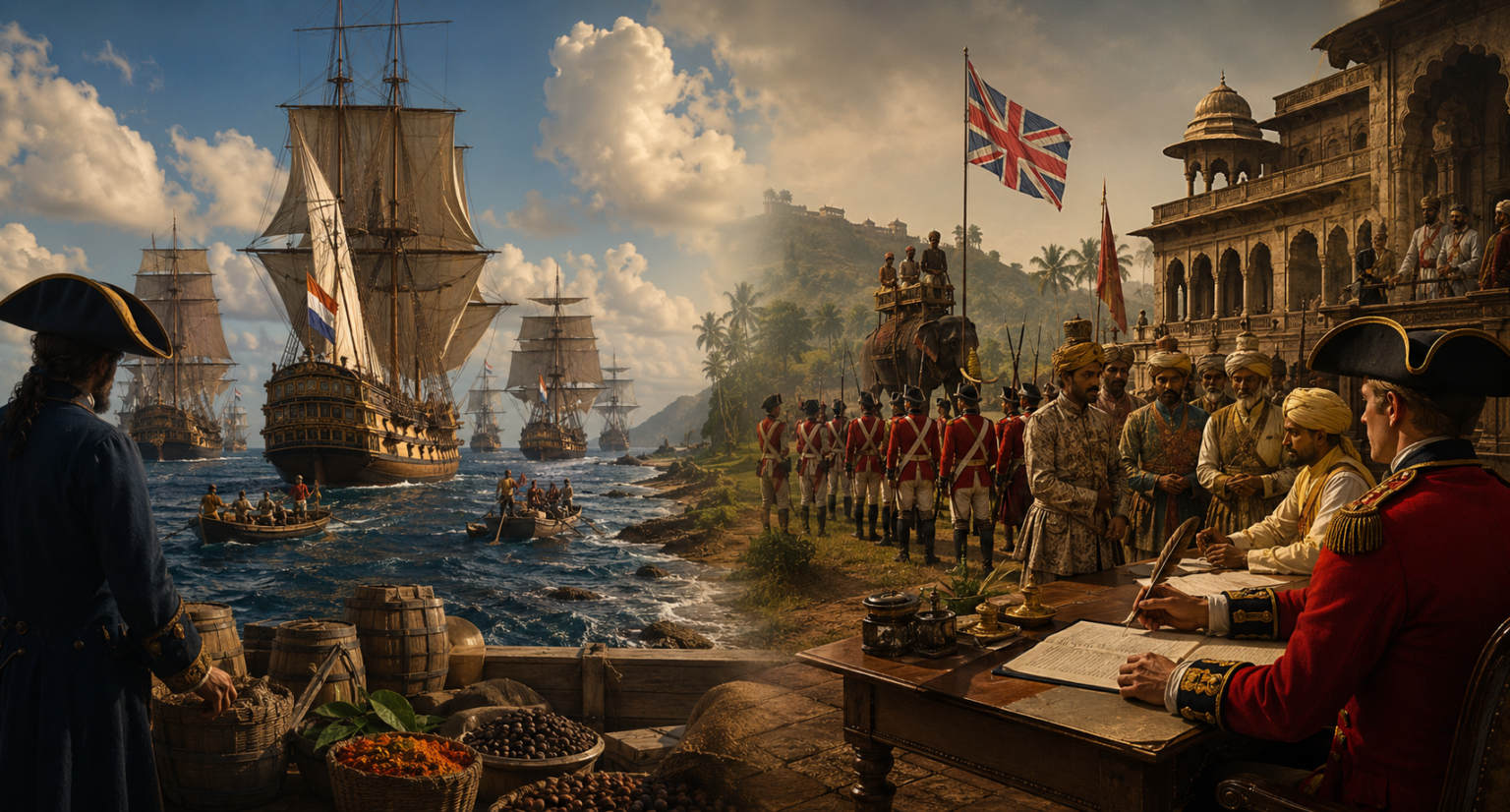
Set the Dutch and English stories side by side, and the pattern from Portugal’s own playbook — fortify, license, monopolize — repeats itself almost exactly, just executed by two different companies chasing two different roads.
The VOC took the maritime road all the way to its source: not content to tax the spice trade the way Portugal had, it seized outright control of production on the Spice Islands themselves, backed by a private navy and army larger than most European states could field. The English East India Company took a different road entirely — inland, into the Indian subcontinent, where it built influence gradually through trading posts and treaties before converting that influence into direct territorial rule after Plassey. Both were, in the truest sense, still following the founding logic of this entire story: find the road, fortify the road, and once you hold the road, the empire follows almost automatically. Neither the Dutch nor the English set out, in 1602 or 1600, to rule Indonesia or India outright. They set out to move goods more cheaply than Portugal could. The empire was what accumulated once the road was secure.
It’s also worth noting what didn’t change. Portugal’s Cartaz system had rested on a combination of naval force and a licensing bureaucracy — pay, and sail safely; refuse, and risk seizure. The VOC’s system in the Indies rested on an even more thorough version of the same logic, backed by more ships, more capital, and a corporate structure explicitly designed for both war and commerce simultaneously. And the English Company’s revenue-collecting rights in Bengal after 1765 were, functionally, a tax on an entire province rather than a toll on a shipping lane — the same underlying principle of “control the flow, extract the value,” just scaled up from an ocean route to a governed territory.
Conclusion: The Road Never Stops Moving
The throughline from the very start of this story holds all the way through. Routes are power — not the goods that travel them, and not even, in the end, the empires that grow up around them, but the corridor itself and whoever controls passage through it. The overland caravan road through the Khyber and Bolan passes gave way to the monsoon sea lanes. Ottoman and Venetian control of the old road pushed Portugal to the Cape. Portugal’s century-long grip on that new road, in turn, pushed the Dutch and the English to build roads of their own — one straight to the source in the Indonesian archipelago, one inland through the Indian subcontinent.
And in both cases, the road didn’t stay a road for long. It became a monopoly, then a company with its own army, then, eventually, something close to a government. Portugal proved the model. The Dutch and the British didn’t just copy it — they industrialized it, financed it more aggressively, and, in the case of the English East India Company, eventually turned an entire trading post system into direct colonial rule over the Indian subcontinent, a rule that would outlast the Company itself and shape the region for two more centuries.
Every empire, it turns out, needs a road. The harder lesson, the one this whole series keeps circling back to, is that every road, left unguarded long enough, eventually becomes someone else’s empire.