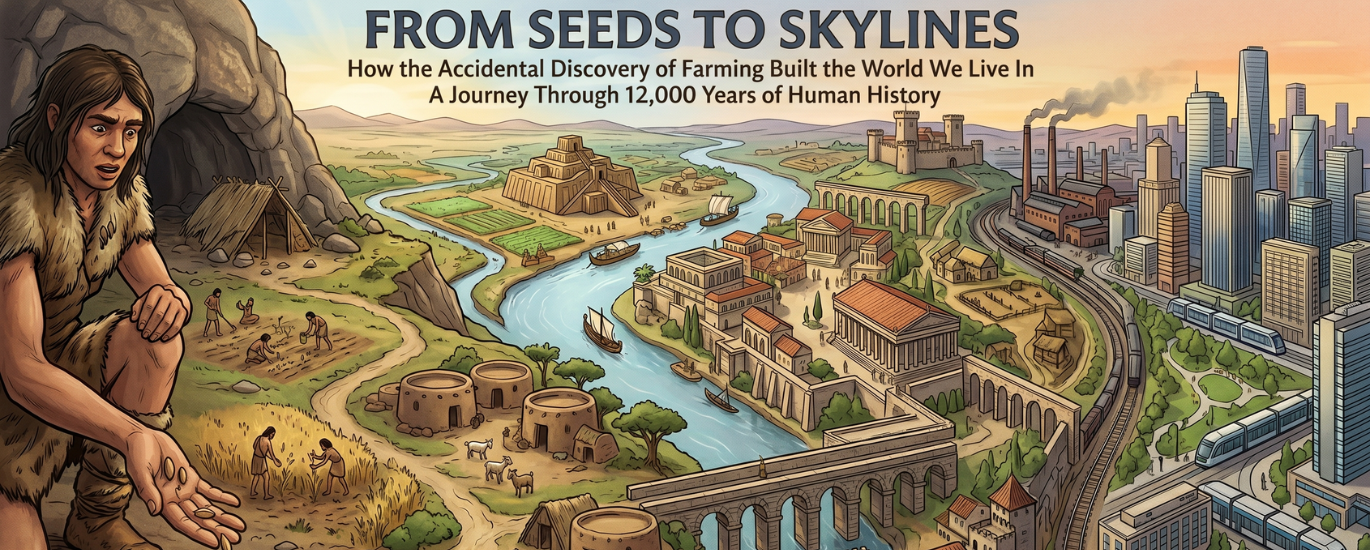
Imagine waking up every single morning with absolutely no idea where your next meal is coming from. No fridge, no market, no corner shop — just the vast, indifferent wilderness stretching out in every direction. You have no address, no home, and no plans beyond survival. This was not a nightmare. For the vast majority of human history, this was simply Tuesday.
For roughly 95% of our time on Earth — about 300,000 years of Homo sapiens existence — every human being who ever lived was a hunter-gatherer. Then, around 12,000 years ago, something happened that changed everything. Not a war, not a meteor, not a god descending from the heavens. It was something far more ordinary, far more accidental, and arguably far more powerful.
A seed fell into disturbed soil near a campsite. It grew. Someone noticed. And the world was never the same again.
Life Before the Plow: The World of the Hunter-Gatherer

Before we can appreciate just how seismic the shift to agriculture was, we need to understand the life it replaced. And here’s where things get surprisingly interesting — because the hunter-gatherer lifestyle was not the brutal, desperate existence most of us imagine.
Hunter-gatherers lived in small, tight-knit bands of roughly 30 to 100 people. They were extraordinarily mobile, following animal migrations, seasonal fruit, and ripening wild grains across vast territories. They slept under stars, in rock shelters, or in temporary camps. Possessions were minimal — anything you owned, you had to carry.
Fun Fact: Studies of modern hunter-gatherer societies suggest these early humans worked as little as 3 to 5 hours a day to meet their food needs. Anthropologist Marshall Sahlins famously called them ‘the original affluent society’ — working less, yet meeting all their needs.
The !Kung Bushmen of the Kalahari, one of the most studied modern foraging communities, were estimated to work roughly two-and-a-half days per week, about 6 hours a day. Compare that to your average 9-to-5 workday and it starts to raise some uncomfortable questions about the direction civilization took.
Their diet was impressively varied — wild game, tubers, nuts, berries, fruits, fish, and honey. Archaeological studies of skeletal remains from this period reveal that pre-agricultural humans were generally taller, had stronger bones, and showed fewer signs of nutritional deficiency than their farming descendants. In short: freedom, variety, and surprisingly decent teeth.
“For 300,000 years, humans wandered the Earth with no fixed address. Then a seed changed everything.”
The Accidental Revolution: How Farming Was Discovered
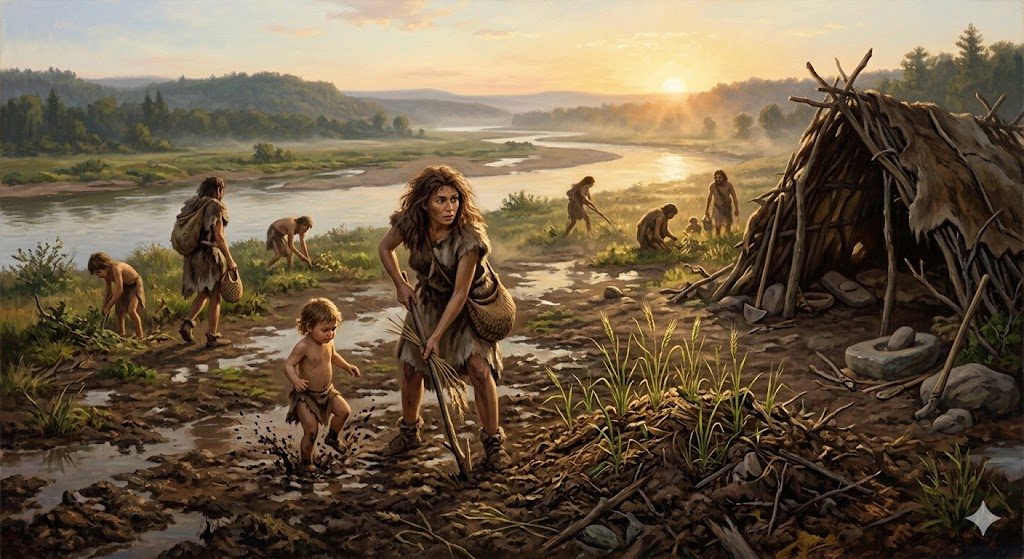
Here is the truly mind-bending part of this story: nobody planned the Agricultural Revolution. There was no prehistoric genius who sat down one day and said, ‘You know what we should do? Plant things.’ It almost certainly happened gradually, accidentally, over generations — and probably in multiple places at once.
The most widely accepted theory goes something like this: Hunter-gatherers, as they moved through the landscape, accidentally scattered seeds near their camps. Perhaps they dropped grain while carrying it, or discarded the husks near their resting spots. Later, passing through the same area, they noticed plants had grown. Over many generations, the most observant among them began to understand the pattern: seeds, soil, water, time — food.
Date Stamp: The earliest evidence of deliberate agriculture dates to around 9,500–8,500 BC in the Fertile Crescent — a crescent-shaped arc of land stretching from modern-day Israel, Lebanon and Syria through Turkey and down into Iraq and Iran.
This fertile patch of the ancient Middle East was, quite literally, where civilization began. The Fertile Crescent had an extraordinary natural advantage: it was home to a remarkable number of wild plant and animal species that happened to be perfectly suited for domestication. Wild emmer wheat, einkorn wheat, barley, lentils, peas, and chickpeas all grew here naturally. Sheep, goats, cattle, and pigs roamed these hills.
Farmers of the Fertile Crescent worked with what scholars call the ‘eight founder crops’: emmer wheat, einkorn wheat, barley, lentils, peas, chickpeas, bitter vetch, and flax. These eight plants, domesticated in this one region, would go on to feed most of the ancient world and form the foundation of Western agriculture for thousands of years.
Archaeological Marvel: Göbekli Tepe in modern-day Turkey, dated to around 9,600 BC, is one of the world’s oldest known temple complexes — and it sits right at the heart of the Fertile Crescent, near the very location where wheat was first domesticated. Some archaeologists believe the need to feed large numbers of workers building this monumental site may have accelerated the push toward cultivating wild cereals.
Interestingly, domestication also happened independently in other parts of the world. Rice and millet were domesticated in China around 7,000 BC. Maize (corn) emerged in Mesoamerica around 7,000 BC. Potatoes were cultivated in the Andes of South America around 8,000 BC. This means humanity discovered farming not once, but many times over — a testament to just how powerful the idea was once conditions made it possible.
The First Villages: Putting Down Roots
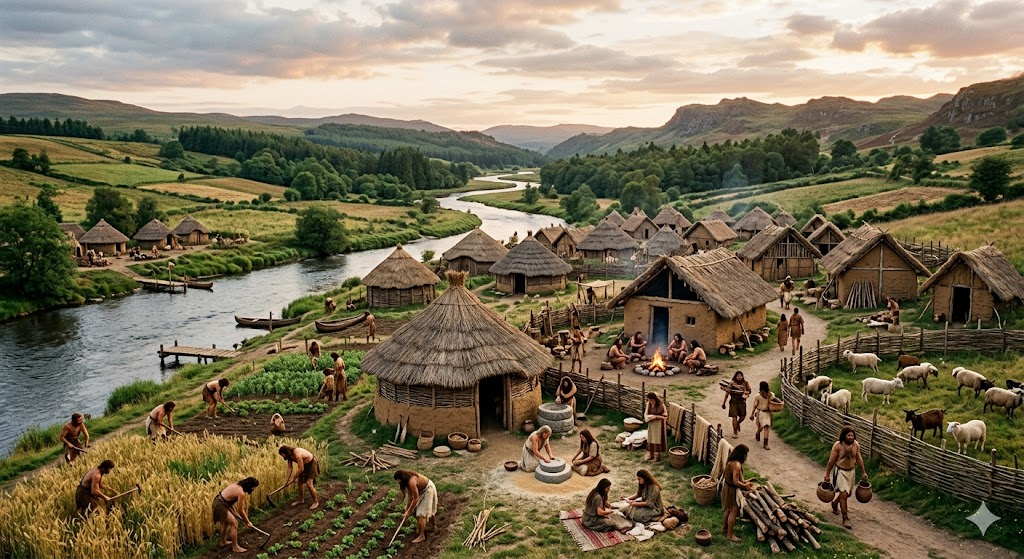
Once people began deliberately cultivating crops, the logic of the nomadic life started to break down. You cannot plant wheat in April and wander off to the next valley. Agriculture demanded something new from human beings: staying put.
And so, for the first time in human history, people built permanent homes. Small clusters of mud-brick houses began to appear, initially in the fertile valleys of the Fertile Crescent. These were humanity’s first villages — humble by any standard, but revolutionary in concept.
World’s Oldest Town: Jericho, in the modern West Bank, is widely considered one of the oldest continuously inhabited settlements in the world. By around 9,000 BC, it had a settlement of perhaps 2,000 to 3,000 people — complete with a massive stone tower (still standing today) and a surrounding wall. This is extraordinary: people were building walls and towers before they had writing, before they had metal tools, and before they had wheels.
Another remarkable early settlement was Çatalhöyük in modern Turkey, occupied between approximately 7,500 and 5,700 BC. Home to up to 8,000 people at its peak, it was a densely packed honeycomb of mud-brick rooms with no streets between them. Residents entered their homes through holes in the roof and climbed down on ladders. They buried their dead beneath the floors of their homes — an early form of ancestor worship that suggests the concept of a ‘home’ had become deeply meaningful to people who, only generations before, had owned nothing.
These early villages were modest, but they contained the seeds (quite literally) of something far larger. When people stay in one place, they accumulate. They accumulate food, objects, children, traditions, knowledge, and — crucially — surplus.
“Food surplus was the original superpower. It freed human hands from the soil and gave rise to everything else.”
The Surplus That Built Cities
Here is the single most important concept in the entire story of civilization: food surplus. When farmers grow more food than they can eat, something remarkable becomes possible — some people no longer have to farm.
Think about what that means. For the first 300,000 years of human existence, virtually every single person spent most of their waking life obtaining food. Farming created, for the first time, the possibility of specialization. If ten farmers could produce enough food for twelve people, those two extra people could spend their days doing something else entirely.
And what did they do? They became priests, soldiers, scribes, potters, weavers, metal workers, merchants, builders, artists, administrators, and kings. They invented writing (initially to track grain inventories), mathematics (to calculate land areas and taxes), astronomy (to predict planting seasons), architecture (to build granaries and temples), law (to settle disputes over land and water rights), and government (to manage it all).
Irrigation & Engineering: The great river valley civilizations — Mesopotamia between the Tigris and Euphrates, Ancient Egypt along the Nile, the Indus Valley Civilization in modern-day India and Pakistan, and Ancient China along the Yellow River — all arose directly from agricultural surplus. They constructed sophisticated irrigation systems to channel river water to their fields, transforming dry land into productive farmland and supporting population densities previously unimaginable.
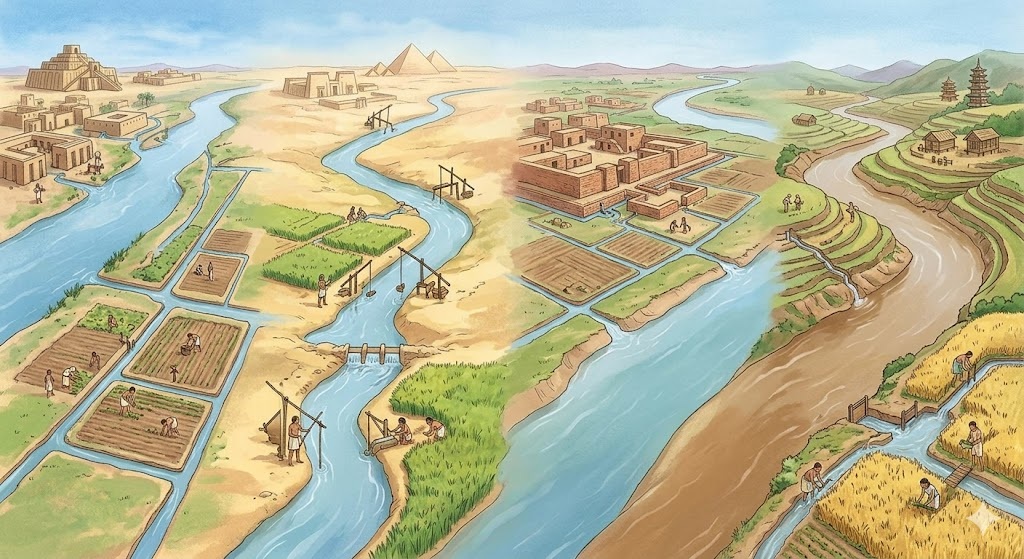
The first true cities emerged in Mesopotamia. By around 3,000 BC, Uruk on the banks of the Euphrates had grown to house between 25,000 and 50,000 people — making it arguably the first metropolis in human history. It had temples, palaces, marketplaces, workshops, residential districts, and an enormous defensive wall. None of this would have been possible without agriculture.
It was in these early Mesopotamian cities that writing was invented around 3,200 BC — not to record poetry or history or religious texts, but to track grain. Clay tablets found at Uruk are covered in accounting marks: so many bushels of barley received, so many rations distributed. Civilization, in its earliest form, was a giant agricultural ledger.
Writing & Wheat: The very first written records discovered by archaeologists are not stories or prayers — they are grain inventory lists from Sumerian cities around 3,200 BC. Writing was, at its origin, a farming technology.
Laws, Leaders & the Logic of Agriculture
Agriculture did not just create cities. It created everything that goes with them: politics, inequality, laws, armies, and empires. And this is where the story gets complicated.
When people are nomadic, it is very hard for any single person to accumulate much more than another. You only have what you can carry. But once people settled down and began accumulating land, livestock, and stored grain, inequality became not just possible, but almost inevitable. Those with the most fertile land, or the most workers, produced more. They stored more. They became wealthier.
Food surpluses also created the possibility of feeding a ruling class — people who produced nothing themselves but who controlled everything: kings, priests, generals, and tax collectors. In historian Francis Fukuyama’s analysis, the agricultural surplus made possible the development of a social elite who were not engaged in food production but who dominated their communities and monopolized decision-making.
Code of Hammurabi (circa 1754 BC): One of the world’s earliest legal codes, written in Babylon under King Hammurabi, contains extensive laws governing agriculture: rules about renting fields, dealing with crop failure, managing irrigation disputes, and the rights and obligations of farmers. Law, as a concept, was in large part a response to the complexities agriculture created.
Water management required central coordination on a scale that kinship groups alone could not provide. Who controlled the irrigation canals controlled life and death. This concentrated power, leading to the emergence of the world’s first true governments and — inevitably — the world’s first wars, fought over the farmland and water rights that were now the foundations of survival.
Agriculture Goes Global: From the Fertile Crescent to the World
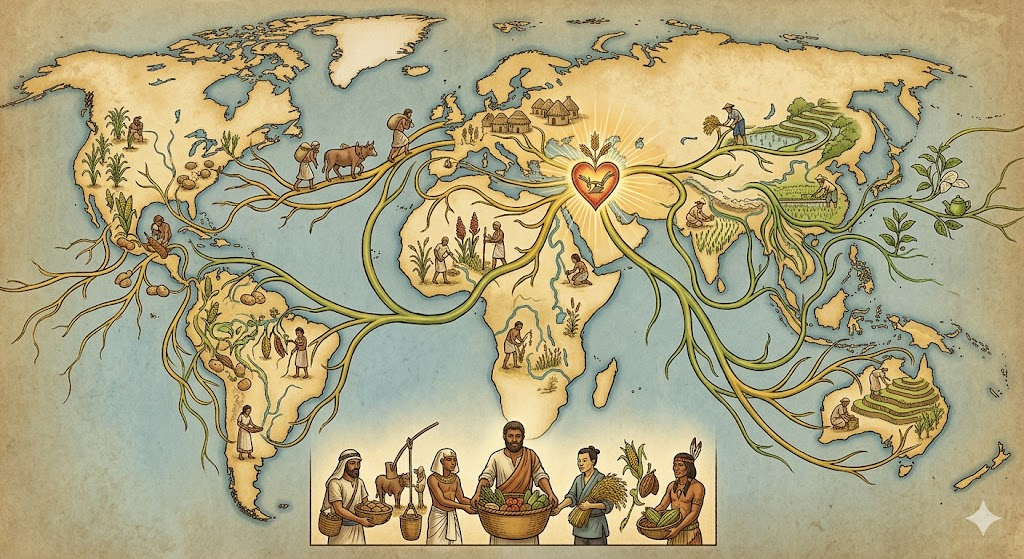
The agricultural revolution did not stay contained to its birthplace. Over thousands of years, farming spread outward from the Fertile Crescent like ink soaking into paper — sometimes carried by migrating farmers, sometimes adopted by local hunter-gatherers who encountered the new way of life.
By 5,000 BC, farming had spread across Europe. By 3,000 BC, it had reached most of sub-Saharan Africa. Independent agricultural revolutions in Asia, the Americas, and Africa created their own crops, their own civilizations, and their own trajectories — rice paddies in China, maize fields in Mexico, taro gardens in New Guinea.
Each of these agricultural societies, in turn, followed a remarkably similar pattern: crops led to surplus, surplus led to specialization, specialization led to cities, cities led to writing and trade and armies and empires. The template was almost universal because the logic was almost universal. Farming is a machine for producing civilization.
India’s Agricultural Heritage: The Indus Valley Civilization, which flourished in modern-day Pakistan and northwestern India between approximately 3,300 and 1,300 BC, was one of the world’s earliest urban civilizations — and was built entirely on agriculture. Cities like Mohenjo-daro and Harappa had sophisticated drainage systems, granaries, and planned street grids. India would go on to become one of the most agriculturally diverse regions on Earth, domesticating rice, cotton, sesame, eggplant, and many other crops.
The sheer scale of the transformation is almost impossible to overstate. At the dawn of agriculture, around 10,000 BC, the entire human population of the Earth numbered perhaps 5 to 10 million people. By 5,000 BC — just 5,000 years into the agricultural experiment — it had climbed to perhaps 50 million. By 1 AD, there were an estimated 300 million humans on the planet. Agriculture had not just fed civilization. It had multiplied it.
The Complicated Truth: Was It Worth It?
Here is where our story gets genuinely thought-provoking. Because while agriculture clearly ‘worked’ in the sense that it produced civilization, it also came with a very real price — and some scholars argue it was not obviously a good trade.
Archaeological studies of skeletal remains show clearly that when populations adopted cereal agriculture, average human health declined significantly. People became shorter. Dental decay became widespread (refined carbohydrates are not kind to teeth). Nutritional deficiencies — particularly iron, zinc, and certain vitamins — increased dramatically. Epidemic diseases, which require large dense populations of people living in close proximity to their own waste and their domesticated animals, became possible for the first time. Smallpox, measles, tuberculosis — all products of the agricultural city.
Paleoanthropologist Jared Diamond, in his landmark work ‘Guns, Germs, and Steel’, famously asked whether agriculture was really progress — or whether it was, as he provocatively suggested, ‘the worst mistake in the history of the human race’. His point was not that civilization is bad, but that the transition to farming imposed real costs on the individual human beings who made it, even as it unleashed forces that would eventually produce antibiotics, space travel, and this very blog post.
But here is the twist: once the agricultural spiral began, there may have been no going back. As populations grew, a landscape that could once feed a tribe of hunter-gatherers could now barely sustain a family of farmers. The more people farmed, the more food they produced; the more food they produced, the more people were born; the more people were born, the more farming was required. Agriculture was, and remains, a commitment.
The Seed That Grew Into Everything
Look around you right now. The room you’re sitting in, the city or village you live in, the phone or computer you’re reading this on, the complex web of trade, law, government, and culture that makes your life possible — every single bit of it traces back, one way or another, to a moment roughly 12,000 years ago when someone in the hills of ancient Turkey or the Jordan Valley noticed that a dropped seed had become a plant.
The cities that followed — Uruk, Babylon, Memphis, Mohenjo-daro, Rome, Chang’an, Tenochtitlan — were not accidents. They were the logical, almost inevitable consequence of what happens when human beings stop wandering and start growing. Farming created surplus. Surplus created specialization. Specialization created complexity. Complexity created civilization.
Every empire that has ever risen, every cathedral that has ever been built, every book that has ever been written, every army that has ever marched, every law that has ever been passed — all of it was made possible because, at some point, enough food existed in one place that some people were freed from the task of finding it.
The farmer, bent over their field at dawn, may be the least glamorous figure in the story of human civilization. But they are, without question, the most important. Before the general, before the king, before the philosopher, before the poet — there was the farmer.
“Civilization didn’t begin in marble palaces or with great speeches. It began in the dirt, with a seed and a pair of calloused hands.”