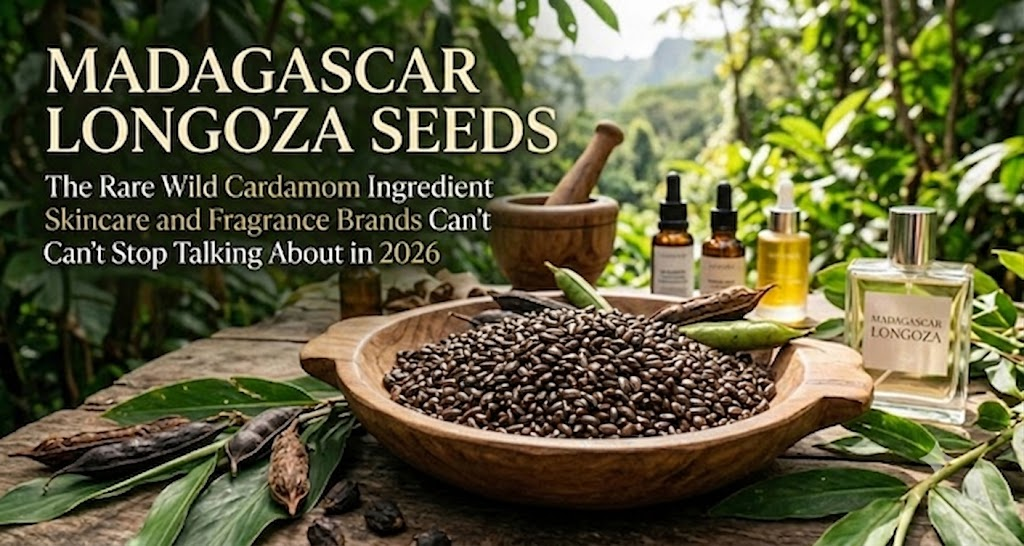
There’s a quiet gold rush happening in the rainforests of Eastern Madagascar, and it has nothing to do with gemstones or vanilla. It’s happening in the understory, beneath a dense forest canopy, where scarlet pods split open to reveal small, dark, intensely aromatic seeds. This is Longoza — botanically known as Aframomum angustifolium — and it’s quickly becoming one of the most talked-about wild botanical ingredients in the cosmeceutical, fragrance, and natural extracts industries.
If you work in product development, sourcing, or formulation and haven’t yet encountered Longoza seeds, you’re about to. Here’s everything you need to know about this endemic Malagasy botanical, why it’s trending, and how it fits into the broader wave of origin-traceable, wild-harvested ingredients reshaping clean beauty and fine fragrance.
 Several converging trends explain why an obscure Malagasy forest botanical is suddenly on procurement teams’ radar.
First, the clean beauty industry is hungry for novel, story-rich actives. Consumers are increasingly skeptical of synthetic, ubiquitous ingredients and are drawn to formulations built around rare, traceable, single-origin botanicals. A wild cardamom relative harvested from Madagascar’s rainforest checks every box: novelty, provenance, and a genuine botanical narrative that brands can build campaigns around.
Second, fragrance houses are on a constant hunt for new “natural modifiers.” The fine fragrance and perfumery world thrives on discovering under-utilized raw materials that can deliver distinctive facets — something that smells familiar enough to be usable, yet different enough to stand out in an increasingly saturated market of familiar spice and woody notes.
Third, there’s a broader supply chain shift toward origin-direct sourcing. Buyers in cosmetics, aromatherapy, and specialty extracts are increasingly bypassing generic distributors in favor of direct relationships with origin countries, prioritizing traceability, ethical wild-collection practices, and batch-level accountability. Longoza fits neatly into this movement as a botanical that simply cannot be replicated outside its native ecosystem.
Several converging trends explain why an obscure Malagasy forest botanical is suddenly on procurement teams’ radar.
First, the clean beauty industry is hungry for novel, story-rich actives. Consumers are increasingly skeptical of synthetic, ubiquitous ingredients and are drawn to formulations built around rare, traceable, single-origin botanicals. A wild cardamom relative harvested from Madagascar’s rainforest checks every box: novelty, provenance, and a genuine botanical narrative that brands can build campaigns around.
Second, fragrance houses are on a constant hunt for new “natural modifiers.” The fine fragrance and perfumery world thrives on discovering under-utilized raw materials that can deliver distinctive facets — something that smells familiar enough to be usable, yet different enough to stand out in an increasingly saturated market of familiar spice and woody notes.
Third, there’s a broader supply chain shift toward origin-direct sourcing. Buyers in cosmetics, aromatherapy, and specialty extracts are increasingly bypassing generic distributors in favor of direct relationships with origin countries, prioritizing traceability, ethical wild-collection practices, and batch-level accountability. Longoza fits neatly into this movement as a botanical that simply cannot be replicated outside its native ecosystem.
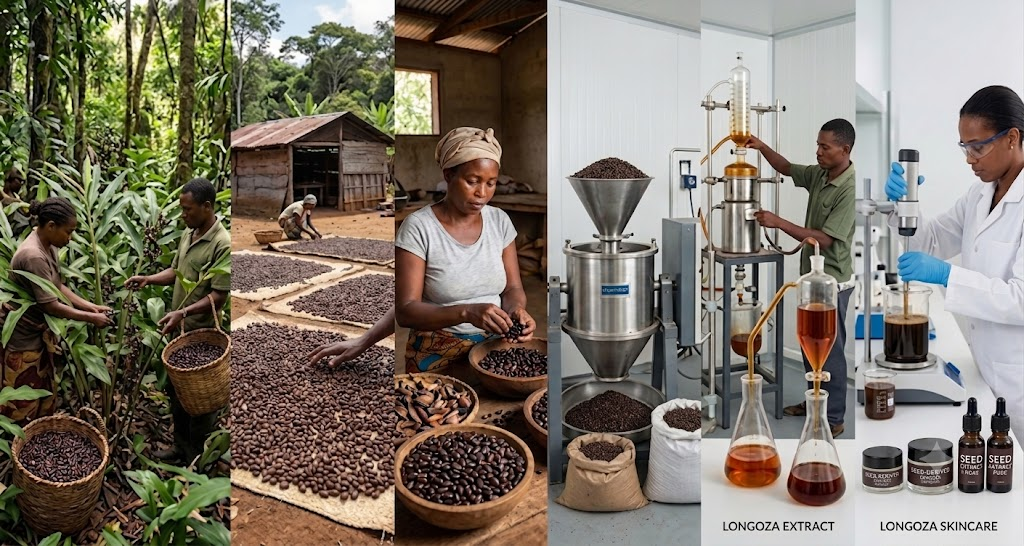 One of the most compelling aspects of Longoza seeds is their processing versatility. Rather than being a single-purpose raw material, the seed supports multiple downstream extraction pathways, each unlocking a different application.
Supercritical CO2 and solvent extraction is used to isolate concentrated bio-active fractions from the seed. These fractions are particularly valued in formulations targeting cellular repair, anti-aging, and premium skincare — categories where consumers and brands alike are willing to pay a premium for ingredients that combine natural origin with demonstrable functional benefit.
Steam and hydro-distillation, by contrast, is the pathway used to produce Longoza Seed Essential Oil. This oil is characterized as a diffusive, warm-spicy modifier suited to fine fragrance work and oriental accord compositions — the kind of ingredient a perfumer might reach for to add depth, warmth, or an unexpected spicy-balsamic twist to a base note structure.
Hydroglycolic and oleoresin extraction rounds out the processing options, producing functional actives suited for cosmetic and personal care applications where a full essential oil isn’t required, but the seed’s active compound profile still needs to be captured in a usable format.
This trifecta of processing pathways is a big part of why Longoza seeds function almost like a Swiss Army knife for formulators — a single raw material capable of feeding three very different production lines.
One of the most compelling aspects of Longoza seeds is their processing versatility. Rather than being a single-purpose raw material, the seed supports multiple downstream extraction pathways, each unlocking a different application.
Supercritical CO2 and solvent extraction is used to isolate concentrated bio-active fractions from the seed. These fractions are particularly valued in formulations targeting cellular repair, anti-aging, and premium skincare — categories where consumers and brands alike are willing to pay a premium for ingredients that combine natural origin with demonstrable functional benefit.
Steam and hydro-distillation, by contrast, is the pathway used to produce Longoza Seed Essential Oil. This oil is characterized as a diffusive, warm-spicy modifier suited to fine fragrance work and oriental accord compositions — the kind of ingredient a perfumer might reach for to add depth, warmth, or an unexpected spicy-balsamic twist to a base note structure.
Hydroglycolic and oleoresin extraction rounds out the processing options, producing functional actives suited for cosmetic and personal care applications where a full essential oil isn’t required, but the seed’s active compound profile still needs to be captured in a usable format.
This trifecta of processing pathways is a big part of why Longoza seeds function almost like a Swiss Army knife for formulators — a single raw material capable of feeding three very different production lines.
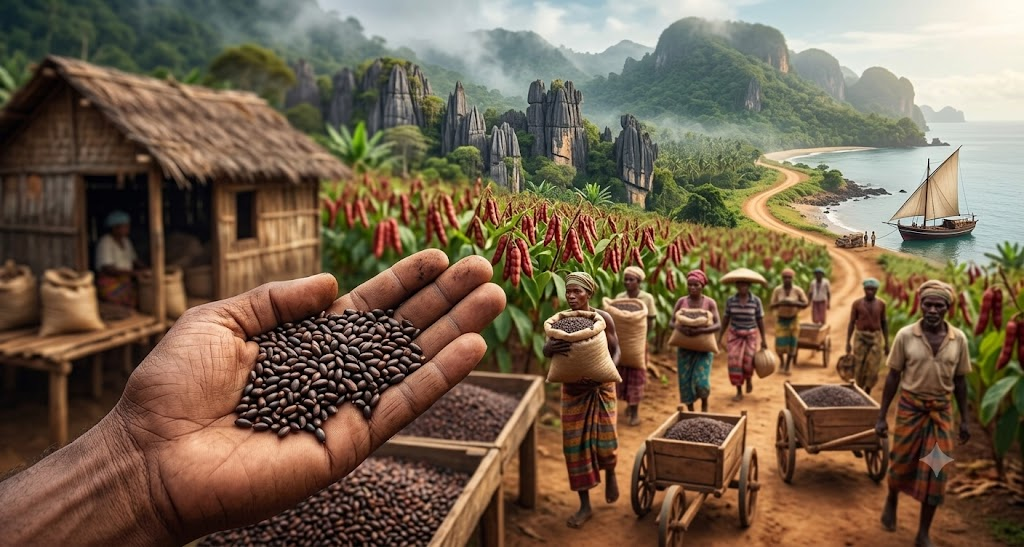 Anyone sourcing botanical raw materials knows that quality begins long before the ingredient reaches a lab bench — it starts with harvesting practices and handling protocols. Storage recommendations for Longoza seed call for cool, dry, well-ventilated conditions, protected from heat and direct sunlight — standard best practice for any raw material where volatile compounds and delicate bioactives are central to its value.
Madagascar’s eastern coast rainforests are already globally recognized as a hub for high-value spice and aromatic production — most famously vanilla, but also cloves, wild pepper, and pink pepper. Longoza seeds fit naturally into this broader portfolio of Malagasy botanicals, and suppliers sourcing from the region often position Longoza alongside complementary offerings such as clove leaf and stem oil, ylang ylang, patchouli, vanilla extract and beans, wild pepper (voatsiperifery), pink pepper (baie rose), black pepper, and cinnamon.
This kind of portfolio integration matters to buyers because it signals supply chain maturity — a supplier capable of delivering Longoza seed reliably is typically also equipped to handle the logistics, quality control, and traceability documentation that serious cosmetic and fragrance brands require, including batch-level traceability for ethically wild-collected material.
Anyone sourcing botanical raw materials knows that quality begins long before the ingredient reaches a lab bench — it starts with harvesting practices and handling protocols. Storage recommendations for Longoza seed call for cool, dry, well-ventilated conditions, protected from heat and direct sunlight — standard best practice for any raw material where volatile compounds and delicate bioactives are central to its value.
Madagascar’s eastern coast rainforests are already globally recognized as a hub for high-value spice and aromatic production — most famously vanilla, but also cloves, wild pepper, and pink pepper. Longoza seeds fit naturally into this broader portfolio of Malagasy botanicals, and suppliers sourcing from the region often position Longoza alongside complementary offerings such as clove leaf and stem oil, ylang ylang, patchouli, vanilla extract and beans, wild pepper (voatsiperifery), pink pepper (baie rose), black pepper, and cinnamon.
This kind of portfolio integration matters to buyers because it signals supply chain maturity — a supplier capable of delivering Longoza seed reliably is typically also equipped to handle the logistics, quality control, and traceability documentation that serious cosmetic and fragrance brands require, including batch-level traceability for ethically wild-collected material.
What Exactly Is Longoza?
Longoza is a perennial plant in the Zingiberaceae family — the same botanical family that gives us ginger, turmeric, and true cardamom. Often described as “wild Malagasy cardamom,” Longoza is endemic to the primary tropical rainforests of Eastern Madagascar, where it grows wild rather than under cultivation. That distinction matters enormously in today’s ingredient market, where “wild-harvested” and “endemic” have become powerful signals of authenticity, rarity, and low environmental footprint. The plant produces mature scarlet forest pods, and inside those pods are the dried seeds that form the raw material at the center of this story. These seeds are naturally rich in a compelling trio of bioactive compound classes: essential volatile terpenes, labdane diterpenoids, and polyphenols. Together, these compounds make Longoza seeds a functional, high-value raw material for both extraction and distillation industries — a rare botanical that bridges the worlds of skincare actives and fine fragrance in a single ingredient.Why Longoza Seeds Are Having a Moment
Several converging trends explain why an obscure Malagasy forest botanical is suddenly on procurement teams’ radar.
First, the clean beauty industry is hungry for novel, story-rich actives. Consumers are increasingly skeptical of synthetic, ubiquitous ingredients and are drawn to formulations built around rare, traceable, single-origin botanicals. A wild cardamom relative harvested from Madagascar’s rainforest checks every box: novelty, provenance, and a genuine botanical narrative that brands can build campaigns around.
Second, fragrance houses are on a constant hunt for new “natural modifiers.” The fine fragrance and perfumery world thrives on discovering under-utilized raw materials that can deliver distinctive facets — something that smells familiar enough to be usable, yet different enough to stand out in an increasingly saturated market of familiar spice and woody notes.
Third, there’s a broader supply chain shift toward origin-direct sourcing. Buyers in cosmetics, aromatherapy, and specialty extracts are increasingly bypassing generic distributors in favor of direct relationships with origin countries, prioritizing traceability, ethical wild-collection practices, and batch-level accountability. Longoza fits neatly into this movement as a botanical that simply cannot be replicated outside its native ecosystem.
The Technical Profile: What Makes Longoza Seeds Valuable
For formulators and technical buyers, the appeal of Longoza seeds isn’t just the story — it’s the specification sheet. Botanically identified as Aframomum angustifolium (Sonn.) K. Schum., the seeds are typically supplied as whole dried seed at a minimum purity of 99.0%, classified under HS code 0908.31.00. Quality-grade Longoza seed generally falls within a moisture content range of 10.0% to 11.5%, tested via the oven drying method, with foreign matter capped at a maximum of 1.0% — meaning the seed is largely free of pod chaff and other organic debris. This level of quality control matters because moisture content directly affects shelf stability, extraction efficiency, and the risk of microbial degradation during storage and transit. On the sensory side, Longoza seeds are described as having a warm, sweet-spicy aroma profile with fresh cardamom and peppery-balsamic undertones — a scent signature that immediately signals its usefulness in both skincare formulation (where aroma influences perceived product quality) and fragrance creation (where it can function as an exotic spicy-balsamic natural modifier). The volatile oil yield from laboratory hydro-distillation typically ranges between 0.8% and 1.8% v/w, and the major volatile compounds identified include 1,8-Cineole, β-Pinene, α-Terpineol, and Caryophyllene — a chemical fingerprint that will be immediately recognizable to anyone familiar with essential oil chemistry. These compounds are widely associated with fresh, camphoraceous, and spicy-woody facets, explaining why Longoza performs so well as both a skincare active and an aromatic ingredient. Beyond the volatile fraction, the seeds’ active marker compounds — labdane diterpenoids, flavonoids, and polyphenols — represent the non-volatile bioactive backbone that makes Longoza especially interesting to the cosmeceutical world, where these compound classes are frequently linked to skin-supportive and antioxidant functionality.From Forest to Formulation: How Longoza Seeds Are Processed
One of the most compelling aspects of Longoza seeds is their processing versatility. Rather than being a single-purpose raw material, the seed supports multiple downstream extraction pathways, each unlocking a different application.
Supercritical CO2 and solvent extraction is used to isolate concentrated bio-active fractions from the seed. These fractions are particularly valued in formulations targeting cellular repair, anti-aging, and premium skincare — categories where consumers and brands alike are willing to pay a premium for ingredients that combine natural origin with demonstrable functional benefit.
Steam and hydro-distillation, by contrast, is the pathway used to produce Longoza Seed Essential Oil. This oil is characterized as a diffusive, warm-spicy modifier suited to fine fragrance work and oriental accord compositions — the kind of ingredient a perfumer might reach for to add depth, warmth, or an unexpected spicy-balsamic twist to a base note structure.
Hydroglycolic and oleoresin extraction rounds out the processing options, producing functional actives suited for cosmetic and personal care applications where a full essential oil isn’t required, but the seed’s active compound profile still needs to be captured in a usable format.
This trifecta of processing pathways is a big part of why Longoza seeds function almost like a Swiss Army knife for formulators — a single raw material capable of feeding three very different production lines.
Where Longoza Seeds Are Being Used
The target industries for Longoza seeds span three closely related but distinct sectors. In cosmeceuticals and skincare, Longoza functions as an upstream botanical active, feeding into formulations designed for skin regeneration and anti-wrinkle claims — categories that continue to command strong consumer interest and premium pricing across global beauty markets. In fragrance and aromatics, the seed’s essential oil serves as an exotic spicy-balsamic natural modifier, giving perfumers a genuinely novel material to differentiate their compositions in a market where truly new natural raw materials are increasingly rare. In specialty extracts and aromatherapy, Longoza contributes to botanical blends and functional natural extract lines, appealing to brands and formulators building products around wellness, ritual, and sensory experience rather than pure cosmetic performance.Sourcing, Handling, and the Madagascar Origin Story
Anyone sourcing botanical raw materials knows that quality begins long before the ingredient reaches a lab bench — it starts with harvesting practices and handling protocols. Storage recommendations for Longoza seed call for cool, dry, well-ventilated conditions, protected from heat and direct sunlight — standard best practice for any raw material where volatile compounds and delicate bioactives are central to its value.
Madagascar’s eastern coast rainforests are already globally recognized as a hub for high-value spice and aromatic production — most famously vanilla, but also cloves, wild pepper, and pink pepper. Longoza seeds fit naturally into this broader portfolio of Malagasy botanicals, and suppliers sourcing from the region often position Longoza alongside complementary offerings such as clove leaf and stem oil, ylang ylang, patchouli, vanilla extract and beans, wild pepper (voatsiperifery), pink pepper (baie rose), black pepper, and cinnamon.
This kind of portfolio integration matters to buyers because it signals supply chain maturity — a supplier capable of delivering Longoza seed reliably is typically also equipped to handle the logistics, quality control, and traceability documentation that serious cosmetic and fragrance brands require, including batch-level traceability for ethically wild-collected material.