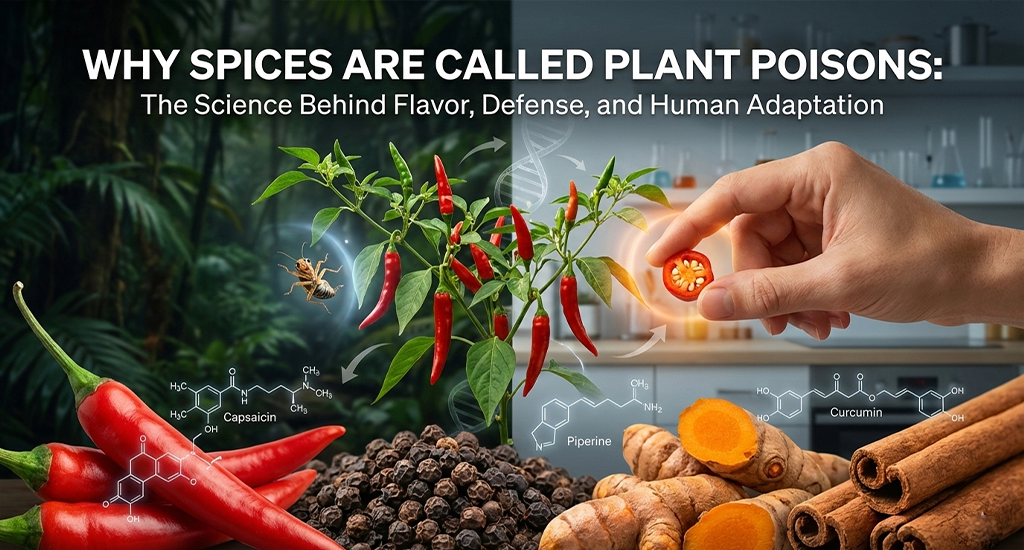
Spices are, in a biological sense, plant poisons. That may sound dramatic, but it is scientifically accurate. Plants cannot run, hide, or fight predators in the way animals can. Rooted to the ground, they evolved a different survival strategy: chemistry. Over hundreds of millions of years, plants developed complex molecules designed to deter microbes, insects, and grazing animals. These chemical compounds function as defense systems — antimicrobial agents, bitter deterrents, and pain-inducing irritants — all intended to prevent being eaten.
And yet, with one remarkable exception, these poisons failed to repel one species: human beings.
Instead of avoiding them, humans embraced them. We learned that in small doses, these “plant poisons” are not only safe but beneficial. They preserve food, enhance aroma, stimulate appetite, and even offer medicinal properties. Nowhere in the world is this relationship more refined, layered, and celebrated than in Indian cuisine. Spices do not merely season Indian food — they define it.
Plants, Chemical Warfare, and Human Curiosity
To understand spices, we must first understand plant evolution. For millions of years, plants battled microbes and insects by producing defensive chemicals. These molecules prevented infection, discouraged consumption, and protected reproductive survival. When mammals later evolved and began grazing widely, plants escalated their chemical warfare. They created compounds that caused pain — burning, stinging, and irritation — to stop animals from overeating them.
Humans, however, did something extraordinary. We experimented. We cooked. We diluted. We combined. We discovered that what is toxic in excess can be medicinal in moderation. This delicate balance became the foundation of spice culture.
Moreover, spices offered practical benefits. Many of these plant chemicals are antimicrobial. In hot, tropical climates like India’s, where food spoilage is rapid, antimicrobial spices became essential tools for preservation. Long before refrigeration, spices helped extend shelf life and protect against foodborne pathogens. What began as plant defense became human advantage.
The Four Building Blocks of Spices
To truly understand why spices define Indian food, we must examine their chemical architecture. All spices can broadly be understood through four layers or building blocks: terpenes, phenolics, pain chemicals, and signature aromas. These layers combine in infinite variations, creating the symphony of flavors that characterize Indian cuisine.
1. Terpenes: The Fragrant Foundation
The foundation of most spices lies in terpenes. In perfume terminology, these are the “top notes” — the first aromas we perceive. Terpenes are volatile molecules responsible for fresh, bright scents. There are broadly four common aromatic profiles within this category.
Citrusy aromas come from molecules like limonene, found in citrus peels and coriander. Piney or eucalyptus-like notes arise from pinene and cineole, present in spices such as cardamom and rosemary. Floral notes are driven by linalool, which gives coriander and basil their delicate fragrance. Minty coolness comes from menthol and carvone, present in mint and caraway.
These molecules were originally antimicrobial and insect-repelling agents. Yet when released through grinding or cooking, they create inviting aromas. Interestingly, spices do not necessarily taste pleasant on their own. Many are bitter. What makes them delightful is their aroma. Smell contributes up to 80 percent of flavor perception. When you enjoy the complex flavor of garam masala or a fragrant biryani, much of that pleasure comes from volatile terpenes reaching your nose.
2. Phenolics: Warmth and Depth
The second layer consists of phenolic compounds. These molecules are heavier, warmer, and more penetrating. If terpenes are the top notes, phenolics are the heart of the fragrance.
Eugenol in cloves provides a sweet, spicy warmth. Cinnamaldehyde gives cinnamon its signature heat. Vanillin offers the comforting sweetness of vanilla. These compounds are even more antimicrobial than terpenes and, in some cases, are medically active.
Clove oil, rich in eugenol, has long been used as a natural anesthetic for toothaches. In slightly higher doses, however, it can be toxic — a reminder of its defensive origin. Similarly, cassia cinnamon, commonly used in India, contains higher concentrations of cinnamaldehyde than Ceylon cinnamon, which is more commonly used in Western desserts.
Phenolics add structure to Indian spice blends. They create the warmth in masalas, the depth in curries, and the comforting familiarity in chai. Without phenolics, Indian food would lack its characteristic richness.
3. Pain Chemicals: The Language of Heat
The third layer is pungency — pain-inducing chemicals designed to deter mammals. Around seventy million years ago, as mammals became dominant herbivores, plants evolved molecules that triggered pain receptors.
Capsaicin in chilies causes the burning sensation associated with spicy food. Piperine in black pepper delivers sharp heat. Gingerol in ginger produces warmth. Sulphur compounds in onions and garlic irritate mucous membranes. Allyl isothiocyanate gives wasabi and mustard their nose-tingling sharpness.
These molecules do not create taste in the traditional sense. They activate pain receptors. Yet humans have developed a taste for this controlled pain. In India, spice heat is not merely tolerated — it is celebrated. The burn of chili, the sharpness of pepper, the warmth of ginger: these sensations stimulate endorphins, enhance appetite, and create emotional satisfaction.
Pungency is central to Indian cuisine. From fiery Rajasthani curries to pepper-rich Chettinad dishes, pain chemicals are integral to regional identities.
4. Signature Aromas: The Soul of Each Spice
The fourth layer consists of unique, one-of-a-kind molecules that define individual spices.
Saffron contains safranal, which smells of hay and honey. Fenugreek and coffee share sotolon, responsible for caramel-like sweetness. Curry leaves contain phenyl ethane thiol, giving them their unmistakable burnt-sulphur note that South Indian cuisine cannot replicate with any substitute.
These signature compounds provide personality. They are the soul of each spice. Without them, spice blends would lack identity.
In Indian cooking, these unique aromas distinguish garam masala from sambar powder, or Kashmiri cuisine from Bengali. Each region crafts its own combinations, guided intuitively by centuries of sensory experimentation.
Spices as Culinary Architecture
Understanding these four layers transforms the way we view spice blends. Like perfumers, Indian cooks construct flavor architectures. Terpenes provide brightness. Phenolics add warmth. Pain chemicals create intensity. Signature aromas deliver identity.
A simple tempering of cumin, mustard seeds, curry leaves, and chilies illustrates this layering. Cumin releases earthy terpenes and phenolics. Mustard seeds contribute sharp isothiocyanates. Curry leaves add unique sulphur notes. Chilies inject capsaicin-driven heat. Together, they form a balanced, multidimensional experience.
This is why Indian cuisine feels complex rather than merely spicy. It is structured chemistry — refined through culture.
The Global Obsession That Changed History
Spices did not only define Indian food; they reshaped global history. European obsession with these plant poisons drove exploration, colonization, and trade routes. For centuries, spices were as valuable as gold. Pepper, cinnamon, cloves, and nutmeg motivated voyages across oceans and fueled imperial ambitions.
The last four hundred years of Indian and Southeast Asian history are deeply intertwined with the European desire for spices. Control of the spice trade meant economic power. What began as plant defense molecules became catalysts for global transformation.
Conclusion: From Poison to Pleasure
Spices are paradoxes. They are poisons that heal, irritants that delight, and defenses that became desires. Through curiosity, experimentation, and cultural evolution, humans — particularly in India — transformed plant chemical warfare into culinary art.
Indian food is not defined merely by ingredients, but by this sophisticated layering of plant chemistry. Every curry, every masala, every tempering reflects millions of years of evolution and thousands of years of human ingenuity.
The next time you inhale the aroma of cardamom in chai or feel the heat of chili in a curry, remember: you are tasting history, chemistry, and survival — all at once.