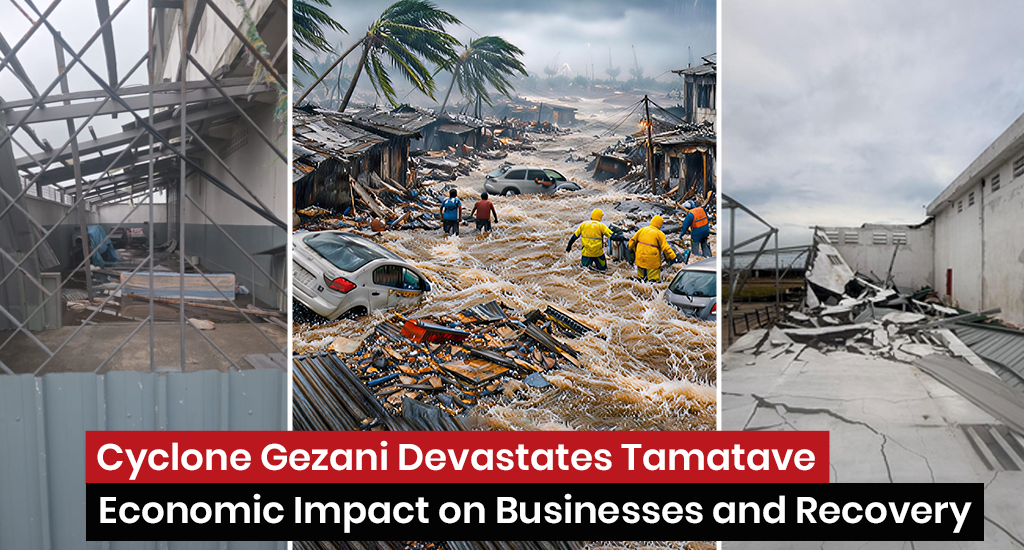
On 10 February 2026, Tropical Cyclone Gezani, one of the most powerful storms to strike Madagascar in recent years made landfall near Tamatave (Toamasina), the island nation’s principal port city on the east coast. With winds exceeding 180 km/h and storm surges reported up to 250 km/h, the cyclone carved a trail of destruction across infrastructure, commerce, and daily life as it moved inland. Not only did it cause significant loss of life and displacement, but it also instantly disrupted trade, supply chains, and the fragile economic fabric of a region already vulnerable from previous storms.
The impact of Gezani cannot be understood as a singular event; rather, it must be contextualized within Madagascar’s ongoing struggle with climate-related hazards, structural economic weaknesses, and historical patterns of cyclone damage. In this blog, we explore how business activity has been affected from major export ports to informal markets and why the fallout extends far beyond the storm.
1. The Initial Shock: Life and Infrastructure in Shambles
When Gezani struck, the first casualty was the physical infrastructure of Toamasina, a city of roughly 300,000 people and Madagascar’s economic pulse due to its port, transport links, and concentrated commercial activity. Authorities confirmed that winds knocked out power grids, uprooted trees, and flattened roofs and buildings across the city. Communications networks failed, leaving businesses cut off from partners and supply networks.
Extended power outages alone can paralyze businesses. Manufacturers cannot operate machinery, exporters cannot process documentation electronically, and cold storage for perishable goods, critical for Madagascar’s fishing and agricultural exports, becomes unusable. In a city already struggling with limited electricity infrastructure, Gezani delivered a blow that will take weeks, if not months, to reverse.
2. Port Operations: A Choke Point for Trade
Toamasina’s port is Madagascar’s largest and most significant for international trade, handling the majority of imports and exports, including vanilla, cloves, coffee, seafood, and minerals that sustain much of the national economy. When the cyclone hit, the port was directly struck by the storm’s strongest quadrant, leading to significant damage to cargo areas, cranes, and docking equipment.
For a country heavily dependent on exports, especially agricultural commodities, even a temporary shutdown of port operations can produce cascading economic losses:
- Export Delays and Contract Risk: Exporters risked missing delivery windows, which can lead to penalties or even cancellation of future contracts, damaging Madagascar’s reputation as a reliable supplier.
- Increased Shipping Costs: With alternative routes or ports potentially unreachable or overwhelmed, shipping costs rise, a cost often passed on to local firms and consumers.
- Import Bottlenecks: Manufacturers and businesses reliant on imported raw materials now face shortages, threatening production schedules and increasing costs.
These disruptions matter not just locally but throughout regional and global supply chains that depend on predictable throughput from Madagascar’s ports.
3. Small and Medium Enterprises: Vulnerabilities Laid Bare
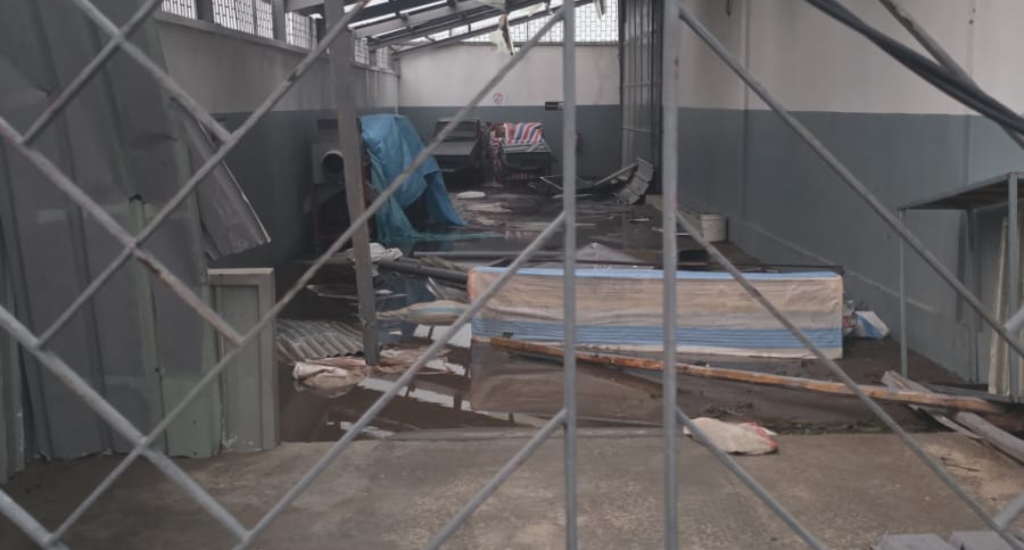
While large firms often have some capacity to absorb shocks through savings or insurance, small and medium enterprises (SMEs) in Madagascar operate with much thinner margins. A vast majority lack formal insurance coverage for natural disasters, meaning losses from destroyed inventory, damaged buildings, or interrupted operations translate directly into financial ruin.
In urban neighborhoods across Toamasina, shops that sell everyday goods lost stock when flooding and wind penetrated storefronts. Artisans and service providers saw their equipment destroyed. Many vendors operate out of makeshift stalls or rented spaces that are especially vulnerable to cyclonic winds and flooding. With no guarantee of compensation or rapid access to capital, these small businesses face the risk of permanent closure.
4. The Informal Economy: Lost Livelihoods and Human Costs
Unlike formal firms that appear in economic statistics, a huge share of Madagascar’s workforce operates in the informal economy, selling goods in open markets, transporting goods and passengers, or working as daily laborers. Estimates suggest that over 80 % of employment in Madagascar falls within this sector. When a cyclone disrupts regular activities, incomes vanish instantly.
The damage caused by Gezani, including market stalls destroyed and foot traffic eliminated due to safety concerns, disproportionately affects these unprotected workers. Without savings or social safety nets, families whose income disappears face food insecurity, inability to access healthcare, and increasing debt burdens.
5. Ripple Effects on Agriculture and Food Security
Although Gezani struck a coastal urban center, its effects radiate outward into rural agricultural communities that depend on the port for export access. Crop producers, especially of vanilla, Madagascar’s most lucrative export, now face hurdles in shipping their produce in a timely manner. Past cyclones have shown that delayed shipments can lead to commodity price drops on global markets, harming farmers’ incomes.
Madagascar’s agricultural sector is particularly susceptible to storms given the country’s geographical position in the southwest Indian Ocean and its reliance on rain-fed farming. Cyclones often destroy fields, reduce yields, and increase post-harvest losses if storage facilities are compromised.
6. Supply Chain and Logistics Disruption
With key transport routes inundated or blocked by debris, intra-national logistics have stalled. Roads connecting Toamasina to its hinterland are impassable in many sections, delaying the movement of goods to and from rural regions. These interruptions extend beyond just immediate storm response, affecting scheduled deliveries, transport of construction materials for rebuilding efforts, and movements of food supplies.
For logistics firms already operating with limited capital and vehicles, such unexpected obstacles not only delay operations but threaten their survival.
7. Human Displacement and Consumption Patterns
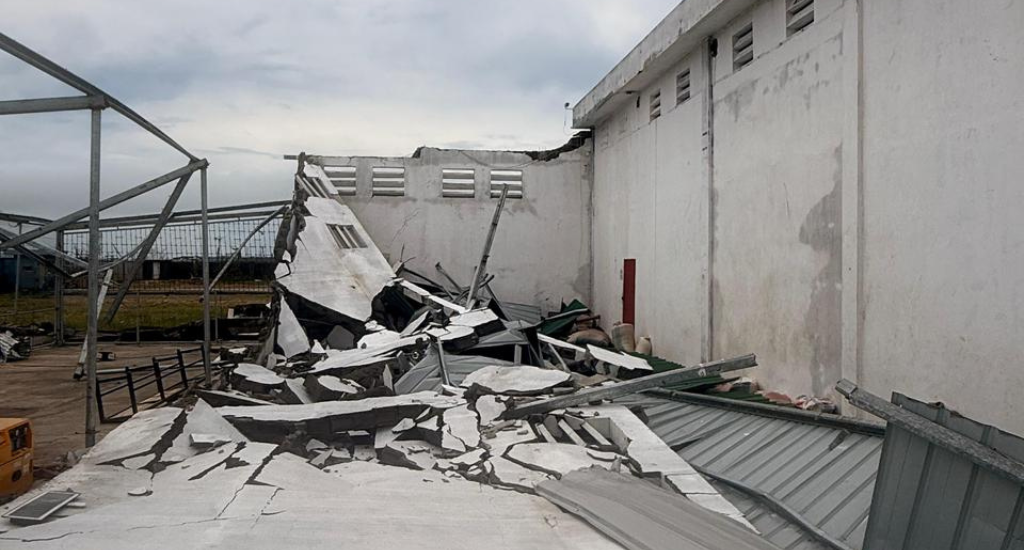
The cyclone displaced tens of thousands of residents. In Toamasina alone, over 6,800 people were evacuated or displaced by flooding and building collapse. Across the affected regions, hundreds of thousands were classified as disaster victims.
Displacement affects the economy by reducing household spending on non-essential goods. With priority on food, water, and temporary shelter, consumer demand for goods such as clothing, entertainment, and services plummets, directly affecting retailers and service providers.
In previous cyclones, reduced consumer demand has led to contraction in local economies lasting several months after the storm, as households prioritize savings and survival.
8. Government Declaration and Emergency Response Imperatives
The Malagasy government has declared a state of national disaster in response to the cyclone’s sweeping impacts. This legal designation enables mobilization of national funds, coordination of international aid, and activation of disaster management protocols. It also reflects the shock’s severity not just to lives but to economic stability.
Governments in similar contexts have drawn on international emergency funds, sought assistance from multilateral institutions, and put in place emergency credit facilities to support business recovery and rehabilitation of infrastructure. For Madagascar, these measures will be vital to restart port operations, restore critical transport links, and provide temporary income support for displaced workers.
9. Historical Cyclone Patterns Highlight Structural Weaknesses
Tropical cyclones are not new to Madagascar; historical events show repeated devastation with long economic consequences. For instance, Cyclone Gafilo in 2004 and other storms have severely damaged industrial installations, crops, and infrastructure in Toamasina and beyond. Past cyclones significantly reduced export crops like vanilla and rice, directly slowing GDP growth and increasing poverty rates.
Yet despite these recurring shocks, Madagascar’s infrastructure remains fragile. Repeated cyclone impacts without substantial strengthening of urban planning, storm-resistant construction, and resilient infrastructure mean economic systems remain exposed.
10. The Future: Rebuilding vs. Resilience
The immediate task after Gezani is recovery restoring electricity, clearing roads, reopening the port, and reopening markets. Yet recovery without resilience merely restores the status quo before the next storm. Madagascar’s economic planners must consider investments in:
- Cyclone-resilient infrastructure (stronger buildings, reinforced ports)
- Diversified supply chains that can withstand disruption
- Financial safety nets for SMEs and informal sector workers
- Improved early warning systems and disaster risk governance
Failure to do so risks a cycle where each storm erodes economic progress, deepens poverty, and compounds future losses.
Conclusion
Cyclone Gezani has struck at a pivotal moment for Madagascar’s economy. It has tested the resilience of businesses, exposed deep structural vulnerabilities, and reminded the world how climate extremes can derail development aspirations. Malagasy leaders, the international community, and private stakeholders now face a critical choice: rebuild the economy as it was, or build it better with resilience at the heart of planning.
Recovery will require not just rebuilding homes and roads, but strategic investments that protect livelihoods and sustain economic activity even in future cyclones. The long-term cost of inaction will be measured not merely in dollars lost today but in opportunities foregone for generations to come.