- May 22, 2026
- 0 comments
- 119 Views
Walk into any pharmacy, fragrance counter, or online store, and the categories blur fast. Deodorant? Perfume? Attar? They all smell good — so are they really that different?
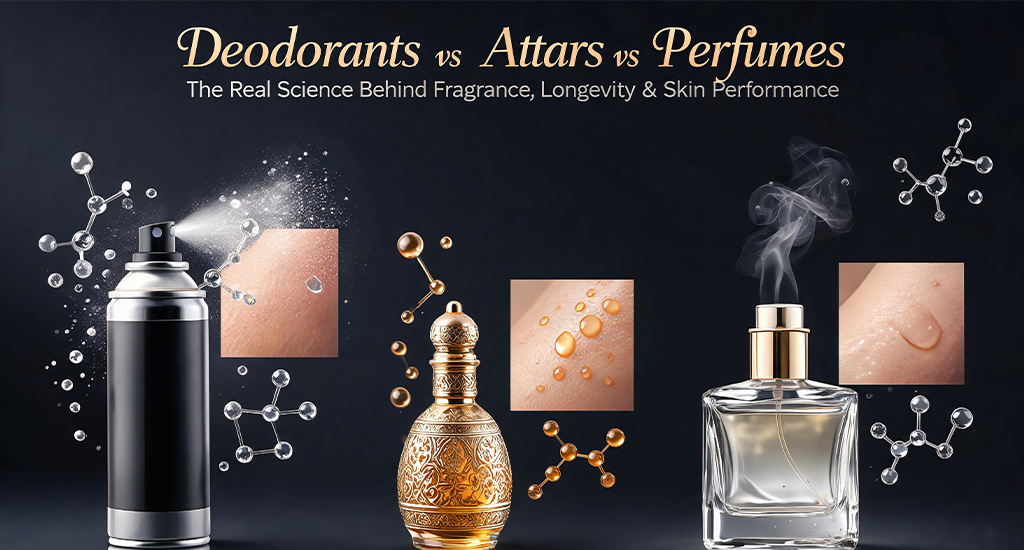
The answer is: completely. Deodorants vs attars vs perfumes aren’t just different products by name — they are built on different science, serve entirely different functions, and behave in fundamentally different ways on your skin. Understanding these differences isn’t just trivia for fragrance enthusiasts. It’s the reason your deodorant disappears by afternoon, your cologne fades by evening, but your attar still whispers on your wrist hours later.
Let’s unpack the chemistry, the carriers, and the culture behind each — and show you how premium fragrance oils like Vetiver oil, Lavender oil, Geranium Bourbon oil, and Patchouli oil (including rare Madagascar-sourced variants) fit into this world.
| 🌿 Explore Our Premium Fragrance Oil Collection — Shop Vetiver, Lavender, Geranium Bourbon & Patchouli Oils |
1. What Each Product Is Actually Designed For
Before we get into the molecules, let’s be clear about purpose — because that’s where the real difference begins.
Deodorants: Odor Control, Not Fragrance
Deodorants exist to neutralize body odor caused by bacterial activity on sweat. The fragrance in a deodorant is secondary — a finishing note, not the main event. Deodorants use antimicrobial agents, baking soda, zinc compounds, or enzyme inhibitors to prevent odor-producing bacteria from thriving. Antiperspirants go a step further, blocking sweat glands with aluminum-based compounds.
Natural deodorant formulations increasingly incorporate functional fragrance oils — Lavender oil for its calming antimicrobial properties, or Patchouli oil for its earthy, grounding scent and mild antibacterial action. These oils do double duty: they contribute pleasant aroma while targeting odor-causing bacteria.
Perfumes: Projection, Presence & Scent Experience
Perfumes — whether Eau de Toilette, Eau de Parfum, or Cologne — are purpose-built for scent diffusion. They’re designed to project into the air around you, leave a scent trail (sillage), and create a sensory impression. Fragrance is the entire function. The carrier, the concentration, and the note structure are all calibrated toward one goal: smell extraordinary.
Fragrance oils like Geranium Bourbon oil (especially the prized Madagascar variety) and Vetiver oil are staple building blocks in fine perfumery — valued for their complexity, tenacity, and ability to bridge floral and earthy fragrance families.
Attars: Intimate Longevity, Rooted in Tradition
Attars (also spelled ittar) are oil-based concentrated fragrance extracts with centuries of history in Middle Eastern, South Asian, and Persian cultures. They don’t project loudly — they linger intimately, close to the skin, evolving slowly throughout the day. Because they’re alcohol-free, they’re favored for religious observance, sensitive skin, and for individuals who prefer a personal scent signature over a fragrance announcement.
Vetiver oil, Patchouli oil, and Geranium Bourbon oil from Madagascar are prized attar ingredients — rich, long-lasting base and heart notes that evolve beautifully on skin over 8–14 hours.
2. Why the Carrier Ingredient Changes Everything
The carrier is the ingredient that holds and delivers fragrance molecules to your skin. It determines projection, longevity, skin feel, and how fast the scent opens. This is arguably the most important variable in fragrance science.
Alcohol-Based Carriers (Most Perfumes & Deodorants)
Ethanol is the dominant carrier in commercial perfumery. It evaporates rapidly at body temperature, and in doing so, it launches fragrance molecules into the air. This is why spraying a perfume fills a room almost instantly.
- Fast evaporation = strong initial projection and immediate diffusion
- Creates a cooling sensation on the skin as it evaporates
- Accelerates the top note phase — which is why citrus and fresh notes hit first
- Fragrance dissipates faster as the alcohol fully evaporates
- May cause irritation on sensitive or dry skin
Oil-Based Carriers (Attars & Concentrated Perfume Oils)
In oil-based formulas, aromatic compounds are dissolved in carrier oils — typically sandalwood base oil, jojoba, fractionated coconut, or neutral white mineral oil. The chemistry here is entirely different.
- Oils don’t evaporate rapidly, so fragrance release is slow and sustained
- Better molecular bonding with the skin’s natural lipid layer
- Vetiver oil and Patchouli oil thrive in oil-based carriers — their deep, resinous character unfolds over hours rather than minutes
- Significantly longer wear time on skin — often 6–12 hours
- No drying effect; can actually moisturize while it scents
Tip: Madagascar Geranium Bourbon oil blended in a jojoba carrier creates an exceptional roll-on attar — floral, slightly rosy, and incredibly skin-friendly.
Water-Based Carriers
Water-based fragrances and deodorant sprays use aqueous solutions as the primary carrier, often with solubilizers to hold the fragrance in suspension. The result is a mild, light scent experience with minimal skin irritation potential. Projection is softer and longevity is lower, making them a good fit for sensitive individuals or minimal-fragrance preferences.
Lavender oil is particularly popular in water-based formulas — it’s soluble enough to disperse well, calming on sensitive skin, and universally pleasant.
3. The Fragrance Pyramid: Top, Middle & Base Notes Explained
Every well-made fragrance is a three-act story told in molecules. Understanding this helps explain why perfumes smell different over time, and why attars and deodorants are formulated so differently.
Top Notes (0–30 minutes)
These are the lightest, most volatile aromatic molecules — citrus, herbs, aquatics, light florals. They evaporate first and create the first impression. In an alcohol-based perfume, they hit hard and fast. In oil-based attars, they’re softer and more fleeting.
Middle Notes / Heart Notes (30 min – 4 hours)
Lavender oil and Geranium Bourbon oil are quintessential heart note ingredients — they bridge the bright top notes and the deep base, providing the fragrance’s core identity. Madagascar Geranium Bourbon, in particular, offers an unusually complex heart: part rose, part mint, part green — making it exceptional in both perfumes and natural attars.
Base Notes (4–12+ hours)
Musks, woody notes, resins, ambers, and oud are the heaviest aromatic molecules. This is where Vetiver oil and Patchouli oil reign. Vetiver’s smoky, earthy depth and Patchouli’s rich, balsamic warmth are among the most classical base note ingredients in global perfumery — and both are among the longest-lasting naturals available.
Attars are built around base notes by design — oud, sandalwood, rose, vetiver, and musk are the most classical ingredients in traditional attar craft.
Fixatives: The Molecular Brake Pedal
Fixatives are ingredients that slow evaporation of fragrance molecules. In high-quality perfumes, fixatives allow a scent to project for hours rather than minutes. In attars, the oil carrier itself functions as a natural fixative. Vetiver oil and Patchouli oil also act as natural fixatives in blends — anchoring lighter notes and extending overall wear time significantly.
Antimicrobial Oils in Deodorants
Deodorant formulations often incorporate functional fragrant oils not just for scent but for odor control: Lavender oil (naturally antimicrobial, gentle on skin), tea tree oil (terpinen-4-ol as active antimicrobial), and eucalyptus oil (cineole-based antimicrobial action). These oils do double duty — they contribute a pleasant fragrance while targeting the bacteria responsible for body odor.
| 🌺 Looking for Natural Deodorant-Grade Lavender Oil? Browse Our Certified Lavender & Geranium Bourbon Collection |
4. Skin Chemistry: Why the Same Fragrance Smells Different on Different People
Fragrance doesn’t exist in a vacuum. It exists on skin — and skin is a living, chemically active surface.
- Skin pH: Slightly acidic skin (pH 4.5–5.5) is the norm, but variations can make top notes sharper or muted. Alkaline skin may suppress citrus notes.
- Skin oiliness: Oilier skin retains fragrance molecules longer, acting like a natural fixative. Dry skin struggles to hold on to scent — especially alcohol-based perfumes. Applying a drop of Vetiver oil or Patchouli oil to pulse points before your perfume creates a natural “fragrance anchor” on dry skin.
- Body temperature: Warmer skin accelerates evaporation and increases projection. Pulse points (wrists, neck, inner elbow) are ideal application zones because of their heat.
- Sweat composition: Individual sweat chemistry reacts uniquely with fragrance molecules. Madagascar Geranium Bourbon oil and Vetiver oil are both renowned for how beautifully they adapt to individual skin chemistry — often smelling subtly different (and uniquely personal) on every wearer.
This is also why deodorants aren’t designed for heavy projection — their scent must remain mild enough to not conflict with sweat chemistry, which varies widely between individuals.
5. EDC vs EDT vs EDP: The Concentration Guide You Actually Need
When shopping for perfume, you’ve likely seen these labels and wondered what they mean. Here’s what the concentrations actually do — and which fragrance oils perform best at each tier:
| Type | Concentration | Longevity | Best For | Key Notes |
| Eau de Cologne (EDC) | 2–5% | 1–2 hrs | Hot weather, casual wear | Light citrus, aquatics |
| Eau de Toilette (EDT) | 5–15% | 3–5 hrs | Daily, office, versatile | Florals, spice blends |
| Eau de Parfum (EDP) | 15–20% | 6–8 hrs | Evenings, cold weather | Patchouli oil, Geranium |
| Parfum/Extrait | 20–30%+ | 8–12+ hrs | Special occasions, luxury | Oud, amber, resins |
| Attar (Oil-based) | Near 100% | 8–14 hrs | Intimate, sensitive skin | Vetiver, Lavender, Rose |
Note: Fragrance oils like Patchouli oil from Madagascar and Vetiver oil are so potent that a near-neat application (as in attars) rivals or surpasses Parfum/Extrait in longevity — often lasting 10–14+ hours on skin.
6. Spotlight: The Fragrance Oils That Belong in Every Category
These four fragrance oils are uniquely versatile — appearing across deodorants, perfumes, and attars alike:
Vetiver Oil
Origin: Madagascar, India, Haiti, Indonesia. Distilled from the roots of Chrysopogon zizanioides. Smoky, earthy, woody, with subtle sweetness. An anchor base note and natural fixative. Used in attars, EDPs, and Parfums worldwide. Pairs beautifully with rose, sandalwood, and citrus.
Lavender Oil
A universal fragrance ingredient — top-to-heart note, calming, herbaceous, slightly floral. Used in natural deodorants, EDTs, fresh attars, and aromatherapy blends. Widely regarded as one of the safest oils for direct skin application when properly diluted.
Geranium Bourbon Oil (Madagascar)
Sourced from Réunion Island as well as central Madagascar, this is considered the world’s finest geranium oil variety — richer, more complex, and more rosy than standard geranium. A prized heart note in fine perfumery and luxury attars. Exhibits slight floral-minty-green character that evolves uniquely on each skin type.
Patchouli Oil (Including Madagascar Patchouli)
Deep, earthy, balsamic, and intensely long-lasting. A foundational base note in countless oriental fragrances, modern perfumes, and traditional attars. Madagascar Patchouli is especially sought after for its smoother, less camphoraceous profile — richer and more refined than standard varieties.
7. Which One Should You Actually Choose?
By Climate
- Hot & humid weather: Stick with EDC or light EDT. Light attars — Lavender oil-based or rose — work beautifully in heat without becoming overwhelming.
- Cold weather: EDP, Parfum, or deep attars built on Vetiver oil, Patchouli oil, or amber thrive in the cold — slower evaporation means richer, more sustained longevity.
By Occasion
- Office & professional settings: Light EDT or minimal deodorant. If layering, a micro-dab of Geranium Bourbon oil on pulse points is subtle and sophisticated.
- Gym & outdoor activity: Deodorant with antimicrobial actives like Lavender oil. Fragrance is secondary — function first.
- Weddings & formal events: EDP or a rich attar featuring Vetiver or Patchouli for a lasting impression without reapplication.
- Daily use: EDT is the sweet spot — moderate projection, moderate longevity.
- Religious observance: Alcohol-free attars are the traditional and culturally considered choice.
By Skin Type & Sensitivity
- Sensitive or dry skin: Avoid high-alcohol EDT/EDP. Opt for oil-based attars or fragrance-free deodorants. Lavender oil diluted in jojoba is exceptionally gentle.
- Oily skin: Works naturally with attars and EDPs. Patchouli oil and Vetiver oil perform especially well on oily skin — longevity can exceed 12 hours.
- Reactive skin: Look for hypoallergenic, IFRA-compliant formulas with clear ingredient lists.
8. Common Fragrance Myths — Debunked
Myth: “Stronger smell means better quality”
Projection is a formulation choice, not a quality marker. Many of the world’s finest attars — built on Vetiver oil, Patchouli oil, or Madagascar Geranium Bourbon — are whisper-quiet in projection but extraordinary in composition.
Myth: “Attars are always natural”
Traditional attars were distilled from real botanicals into sandalwood oil. Modern commercial attars often use synthetic aromatic compounds. Always check the ingredient disclosure — and look for certified natural fragrance oils when natural performance matters.
Myth: “Deodorant and perfume are the same thing”
They share fragrance components but serve opposite primary functions. Applying perfume instead of deodorant won’t stop body odor.
Myth: “More spray = longer lasting”
Over-application saturates your scent receptors (olfactory fatigue) and doesn’t make the fragrance last longer. Two targeted sprays on pulse points outperform seven random ones. With potent oils like Vetiver or Patchouli, a single dab is often more than enough.
9. Frequently Asked Questions
Is attar better than perfume?
Neither is universally better — they serve different needs. Attars offer intimacy, longevity, and alcohol-free performance. Perfumes offer stronger projection and wider scent variety. The best choice depends on your lifestyle, skin type, and occasion.
Why do perfumes last longer than deodorants?
Perfumes contain significantly higher concentrations of aromatic compounds (5–30%) compared to deodorants (typically under 1–3%). The carrier, fixatives, and base-note structure in perfumes are all engineered for longevity. Deodorants prioritize function over fragrance persistence.
Which fragrance type is best for summer?
Eau de Cologne (EDC) or a light Eau de Toilette is ideal for summer. Lavender oil-based attars also perform well in warm climates. Avoid heavy EDP or Patchouli oil-dominant formulas in extreme heat — reserve those rich bases for cooler evenings.
What does EDP mean in perfumes?
EDP stands for Eau de Parfum. It contains 15–20% aromatic concentrate, making it richer, longer-lasting, and more expensive than EDT or EDC. It’s the most common “full-strength” format for modern fine fragrances.
Are alcohol-free fragrances safer for skin?
For sensitive skin, alcohol-free oil-based or water-based fragrances are generally gentler and less drying. Lavender oil and Geranium Bourbon oil are among the most skin-compatible fragrance oils available — both widely used in certified natural skincare and fragrance formulations. Always patch-test any new formula and look for IFRA-compliant products with clear ingredient disclosure.
What is Geranium Bourbon oil from Madagascar?
Geranium Bourbon (Pelargonium x asperum) is steam-distilled from geranium leaves grown on the island of Réunion, often grouped with Madagascar sourcing due to geographic proximity. It is considered the gold standard of geranium oils in perfumery — richer, more floral, and more complex than standard geranium. It’s widely used in luxury perfumes, attars, and natural skincare.
Can Vetiver oil be used in deodorants?
Yes — Vetiver oil’s natural antibacterial properties and earthy, smoky scent make it an excellent addition to natural deodorant formulations. It functions both as a functional antimicrobial and as a long-lasting woody-earthy fragrance note. Typically used at 0.5–2% in deodorant stick or spray formulations.
Conclusion: Fragrance Is a Science — Not Just a Preference
When you understand the science behind deodorants vs attars vs perfumes, the world of fragrance becomes considerably less confusing — and considerably more interesting.
Deodorants are functional hygiene products designed for odor control, not scent performance. Perfumes are engineered for projection, diffusion, and emotional impact. Attars occupy a uniquely intimate space — oil-based, slow-releasing, deeply skin-bonded, and steeped in centuries of fragrance tradition.
The carrier ingredient is the heart of it all. Alcohol opens and launches; oil holds and evolves; water softens and tempers. And within the oil-based world, fragrance oils like Vetiver oil, Lavender oil, Geranium Bourbon oil (Madagascar), and Patchouli oil represent the finest building blocks available to perfumers, formulators, and fragrance lovers alike.
The best fragrance for you isn’t the most popular one, the most expensive one, or the one with the most bottles sold. It’s the one built for your skin, your lifestyle, and your intent. Explore with intention — not just trend.
| ✨ Start Your Fragrance Oil Journey — Shop Premium Vetiver, Lavender, Geranium Bourbon & Madagascar Patchouli Oil Today |