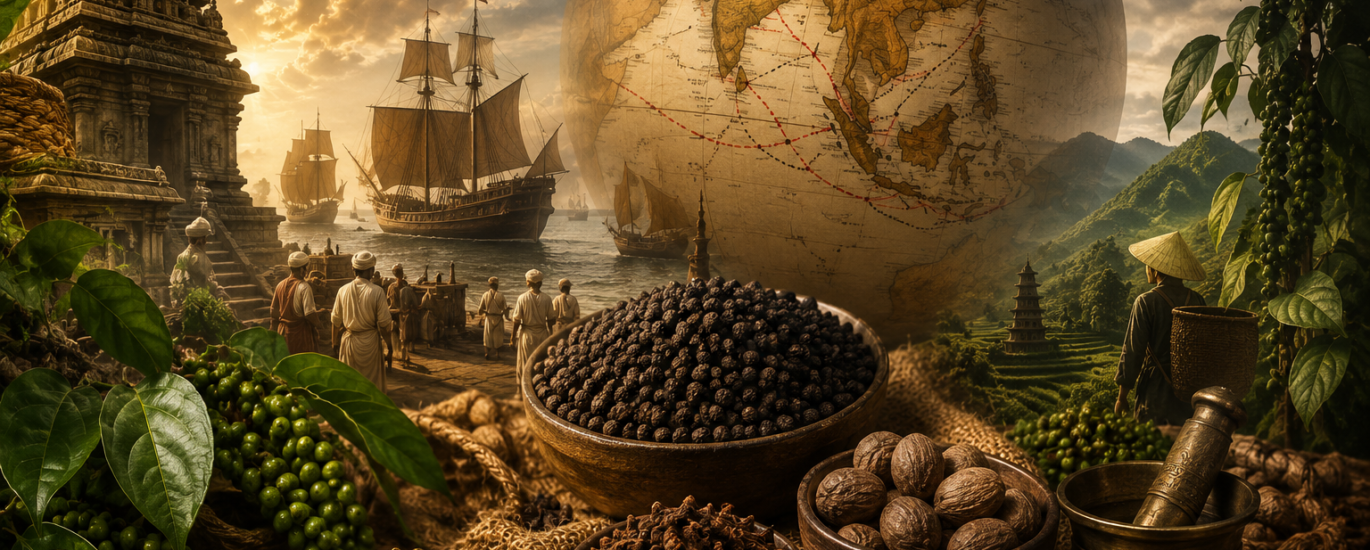
The Epic Journey of Pepper, Cloves & Nutmeg from the Malabar Coast across the Spice Islands of Indonesia to the Highlands of Vietnam
PROLOGUE: THE WORLD’S MOST COVETED CARGO
Imagine a world where a pocketful of dried berries could buy a house in Rome, where wars were waged over tiny volcanic islands, and the desire for flavour reshaped the map of the globe. This was the world of spices — and for over three millennia, at its very centre stood India.
Kerala’s Western Ghats produced the black peppercorns ancient Romans called “black gold.” The remote Maluku Islands of what is today Indonesia yielded cloves and nutmeg worth more than their weight in gold. Vietnam — then a constellation of trading kingdoms along a long coastline — served as the indispensable maritime crossroads. This is the story of how these spices moved through history, how Indian merchants spread not just commerce but civilisation itself, and how a war-ravaged Vietnam eventually rose to become the planet’s undisputed pepper champion.
I. THE ANCIENT CORRIDOR: INDIA RULES THE SEAS
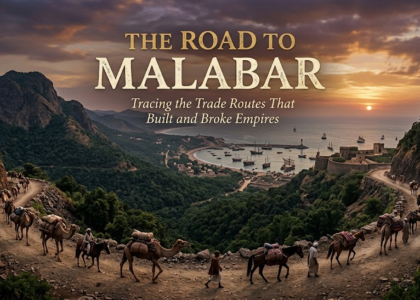
The Indian Ocean was a bustling superhighway of commerce long before European ships appeared on the horizon. Archaeological evidence confirms that a maritime spice network had formed as early as 1500 BCE, linking the forests of Kerala with the islands of Southeast Asia. Indian merchant sailors — armed with intimate knowledge of the monsoon winds — sailed south and east in their sturdy dhows, reaching Burma, the Malay Peninsula, Sumatra, and Java. Between June and September, the southwest monsoon carried ships from India towards Southeast Asia; between October and March, the northeast monsoon reversed the current and brought traders home. Ancient Indian mariners mastered these seasonal rhythms centuries before any other civilisation.
By around 120 BCE, a dramatic event transformed the trade’s geography. A shipwrecked Indian sailor washed ashore on the Red Sea coast of Egypt and revealed to Greco-Egyptian traders how to harness the monsoon winds directly across the Arabian Sea to India — shattering an Arab monopoly that had endured for over a thousand years. Greek and Roman merchants flooded into the Indian Ocean, and the spice trade exploded. A 9,000-mile maritime network evolved, stretching from Rome across the Mediterranean to North Africa, through the Indian Ocean all the way to Indonesia and China — with India at its centre.
Black pepper (Piper nigrum) was native to Kerala’s Western Ghats, harvested wild for millennia before becoming a global commodity. Cloves and nutmeg, however, were native to an even more remote source — the Maluku Islands of eastern Indonesia, known to history as the Spice Islands. These spices reached India through a complex relay of Austronesian, Javanese, and Malay traders who carried them westward across the Java Sea. India was the hub; Maluku was the source. A clove found at the ancient trading site of Manthai in Sri Lanka — dated to 900–1100 CE — had already travelled 7,000 kilometres from the Maluku Islands before it arrived there, almost certainly passing through the hands of Indian intermediary merchants.
II. INDIA PLANTS ITS CIVILISATION IN INDONESIA & VIETNAM
The Indianisation of the Archipelago
The movement of spices from India to Southeast Asia was not merely commercial — it was civilisational. As Indian merchants sailed to the islands of Sumatra, Java, and the Maluku archipelago, they did not simply trade and leave. They stayed, married into local communities, built temples, and brought with them the cultural tapestry of India: Sanskrit, Brahmi script, Hindu cosmology, and Buddhist philosophy. Hinduism and Buddhism literally sailed in the same ships as pepper and cloves.
The kingdoms that emerged from this exchange were vigorous hybrid civilisations. The Srivijaya Empire of Sumatra (7th–13th century CE) became a Buddhist centre of learning rivalling the great monasteries of India. The Majapahit Empire of Java (14th century CE) controlled Java, Sumatra, the Malay Peninsula, parts of Borneo, and critically the Maluku Spice Islands — assembling the most valuable spice empire in history under a Hindu-Buddhist monarchy whose very legitimacy derived from Indian cultural frameworks. The magnificent temples of Borobudur and Prambanan in Java stand today as stone monuments to the civilisational exchange that the spice trade made possible.
By the middle of the 14th century, the Majapahit kingdom controlled most of Java, Sumatra, the Malay Peninsula, parts of Borneo, the southern Celebes, and the Moluccas — the world’s most valuable spice empire, built on Indian religion and Indian trade networks.
The Champa Kingdom: India’s Footprint in Vietnam
In 192 CE, Austronesian settlers in the Annam region of what is today central Vietnam established a kingdom that would endure for over 1,600 years: Champa. And Champa was unmistakably Indian. Its people adopted Sanskrit as their sacred language, used the Brahmi script for inscriptions, followed the Indian calendar and astronomical systems, and worshipped Shiva as their principal deity. The kingdom’s five major territories — Vijaya, Panduranga, Indrapura, Amaravati, and Kauthara — all bore Sanskrit names.
Indian traders did not merely sell to the Cham people — they transformed them. Hinduism was the dominant faith of Champa until 1471 CE. Even today, a small community called the Balamon Cham practices Hinduism in southern Vietnam — one of only two non-Indian indigenous Hindu communities in the world, the other being in Bali. The sea surrounding the Champa kingdom was called the Champa Sea; we know it today as the South China Sea.
It was through these Champa trade networks, maintained by Tamil-speaking merchants from southern India, that black pepper — Piper nigrum, native to Kerala — arrived in Vietnamese soil. The fertile island of Phu Quoc and the Central Highlands were early cultivation zones, a botanical transplant that would lie dormant for centuries before Vietnam weaponised it in the 20th century.
Buddhism reached Vietnam through a parallel route: overland from China, which had conquered northern Vietnam in 111 BCE, and by sea from India through Champa. An Indian monk, Vinitaruchi, introduced the first Zen meditation school to Vietnam in the 6th century CE after studying in China — a perfect symbol of Vietnam’s dual cultural inheritance.
III. THE EUROPEAN HIJACK: BLOOD, MONOPOLY & EMPIRE
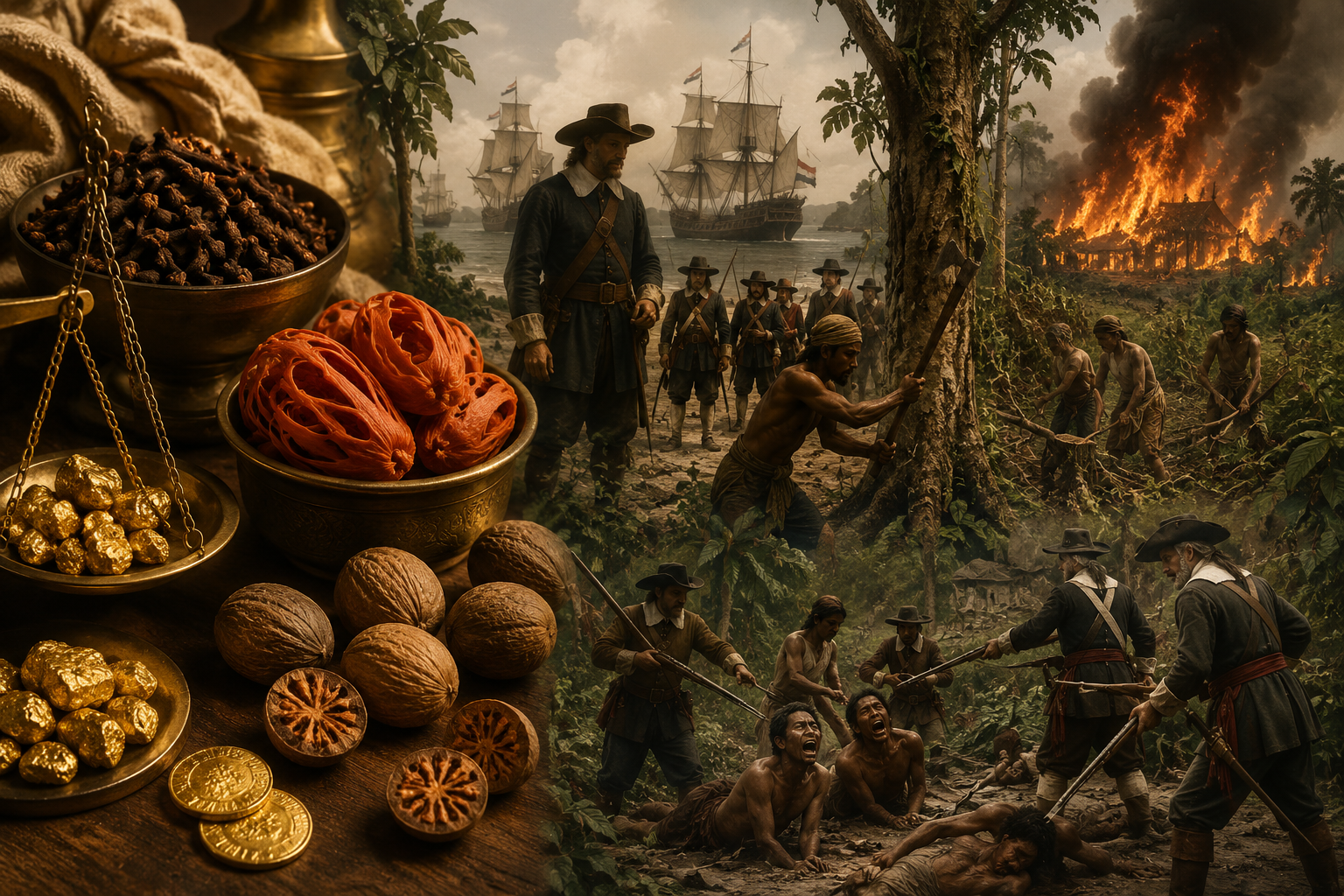
For centuries, the spice trade’s profits were divided among Arab and Venetian intermediaries, each adding their markup as goods moved westward. By the time black pepper reached Florence or London, markups could reach 3,000 percent from source to sale. European powers burned with the desire to cut out the middlemen.
The breakthrough came on May 20, 1498, when the Portuguese navigator Vasco da Gama dropped anchor off Calicut, Kerala — the first European ship to reach the source of pepper by sea. His return cargo was worth 60 times the voyage’s cost. The race to seize the spice trade had begun. The Portuguese moved swiftly and violently: in 1511, they captured the trading city of Melaka; in 1512, Francisco Serrão became the first European to reach the Maluku clove islands; by 1522, Portuguese forts studded the Spice Islands.
The Dutch arrived next and proved even more ruthless. In 1602, competing Dutch interests were consolidated into the Vereenigde Oost-Indische Compagnie — the VOC — granted powers to wage war, govern territories, and coin money. It was a private colonial empire. In 1621, VOC Governor-General Jan Pieterszoon Coen orchestrated the massacre or enslavement of virtually the entire indigenous population of the Banda Islands — an estimated 15,000 people — to secure a complete nutmeg monopoly. To maintain clove prices, the VOC ordered the destruction of all trees outside VOC-controlled areas. Whole villages were razed. The VOC became one of the wealthiest corporations in human history; the Banda Islanders were annihilated for nutmeg.
Nutmeg, mace, and cloves were easily worth more than their weight in gold in European markets. The VOC enforced its monopoly with scorched-earth tactics — extirpating thousands of trees and massacring those who resisted. The Maluku Islands’ natural wealth came at a staggering human cost.
The Dutch monopoly eventually collapsed through smuggling. French colonial official Pierre Poivre — his name the French word for pepper — extracted clove and nutmeg seedlings from the Banda Islands and planted them in Mauritius in the 1770s. The British transplanted cloves to Zanzibar, which became the world’s largest clove exporter. Indonesia survived as a producer but lost its monopoly forever. Today, Indonesia’s clove production feeds primarily its own domestic market — the uniquely Indonesian kretek cigarette, a tobacco-clove blend, consumes approximately 90 percent of the country’s clove harvest.
IV. VIETNAM’S PEPPER REVOLUTION: THE DOI MOI MIRACLE
1986: The Year Everything Changed
By 1986, Vietnam was a country in crisis. Rigid central planning had strangled agriculture; farmers worked on collectives with no personal incentive. Inflation reached 700 percent, and the economy survived on Soviet aid of $4 million a day. At the Communist Party Congress of December 1986, Vietnam launched Doi Moi — “renovation” — dismantling collective farming, returning land-use rights to individual households, and opening the economy to international markets. The effect on agriculture was electrifying.
For black pepper, Doi Moi was a starting gun. Cultivation had existed modestly in Vietnam since the Champa era — on Phu Quoc Island and scattered parts of the southern highlands. Now, freed to plant what they chose and sell to whom they wished, farmers in the Central Highlands provinces of Dak Lak, Dak Nong, Gia Lai, and Binh Phuoc began converting forestland and unused terrain into dense pepper plantations at a pace that astonished international observers.
The Science That Left India Behind
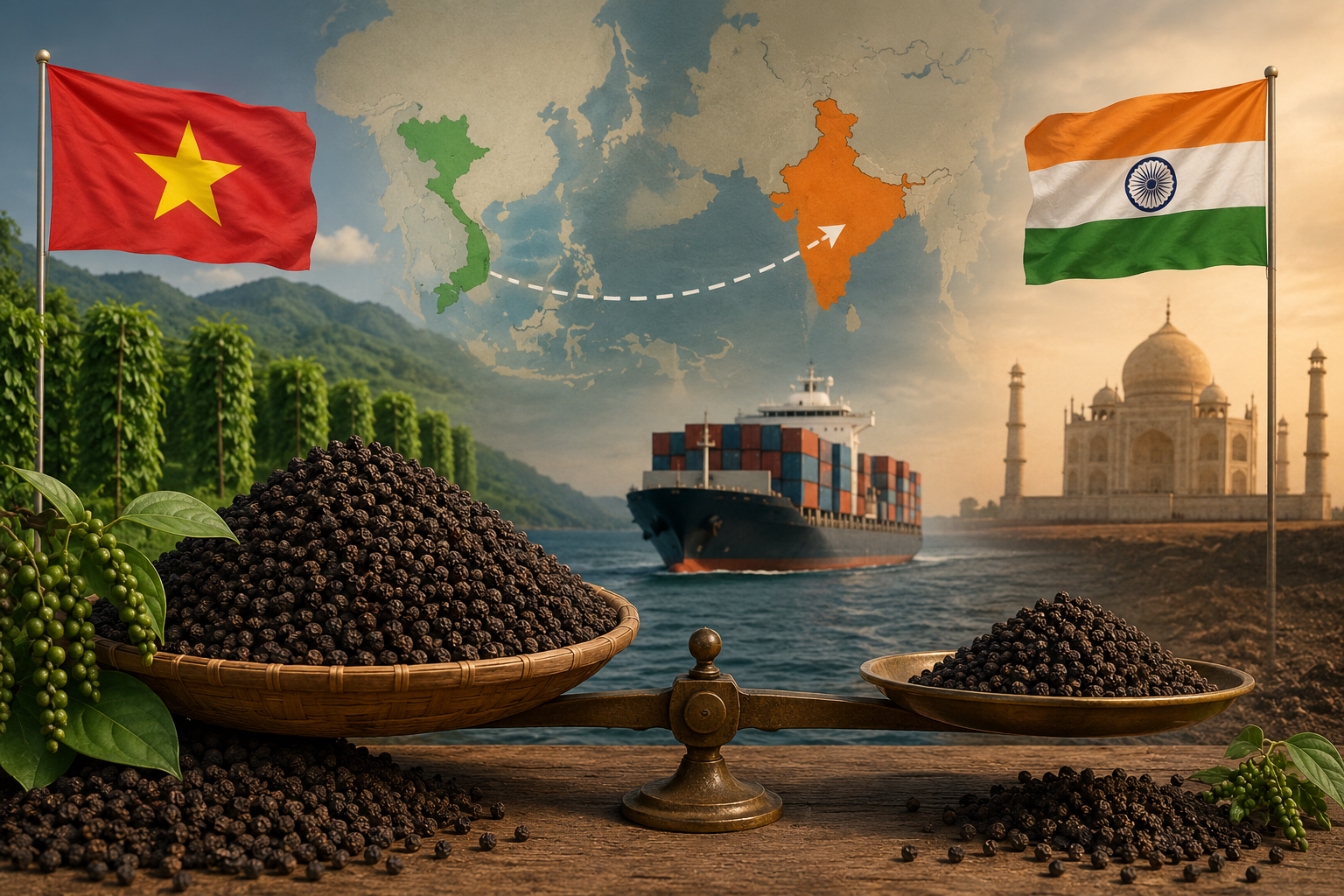
Vietnam’s rise over India is not simply a story of more land — it is a story of superior agricultural science applied with national purpose. India’s pepper farming in Kerala remains largely traditional: small family holdings where Piper nigrum vines climb living trees in mixed-crop systems inherited from ancient practice. Kerala’s laterite soils are acidic with low water retention. Disease — particularly “quick wilt” caused by the soil pathogen Phytophthora capsici — has repeatedly ravaged Indian plantations, and India’s fragmented, unorganised spice market has failed to deliver consistent pricing or technical support to farmers.
Vietnam took an entirely different approach. In the flat-to-rolling terrain of the Central Highlands, farmers trained pepper vines on concrete or wooden poles rather than trees, enabling denser planting — over 1,000 vines per hectare versus India’s traditional 200–400. High-yielding varieties developed by government agricultural institutes replaced traditional seed stocks. Irrigation systems, fertiliser schedules, and integrated pest management were systematically taught through extension services and the Vietnam Pepper and Spice Association. The results were decisive: Vietnamese farmers achieved yields of approximately 2,210 kg per hectare. India’s average in the same period was around 402 kg per hectare — less than one fifth of Vietnam’s output per unit of land.
In 1996, Vietnam’s moment arrived. El Niño-related drought and disease simultaneously devastated harvests in Indonesia, Malaysia, and Brazil. Vietnam — its plantations now mature and expanding — stepped into the breach with abundant supply. International buyers discovered Vietnamese pepper was plentiful, consistent in quality, and competitively priced. By 2014, Vietnam had become the world’s largest pepper producer, commanding 58 percent of global market share and generating one billion dollars in export revenue.
Vietnam produced 272,235 tonnes of black pepper in 2022 — over 34% of world output, and more than four times India’s 64,205 tonnes. India, the birthplace of black pepper, now imports Vietnamese pepper to meet its own domestic consumption.
Vietnam also wielded trade policy strategically. As one of only four Asian nations to sign a free trade agreement with the European Union — the EVFTA, effective August 2020 — Vietnamese pepper enters EU markets at near-zero tariff rates. India, Indonesia, and Malaysia lack equivalent agreements, giving Vietnam a structural price advantage in the world’s most lucrative spice market. By 2022, Vietnam exported pepper to over 105 countries and territories.
EPILOGUE: THE WHEEL TURNS
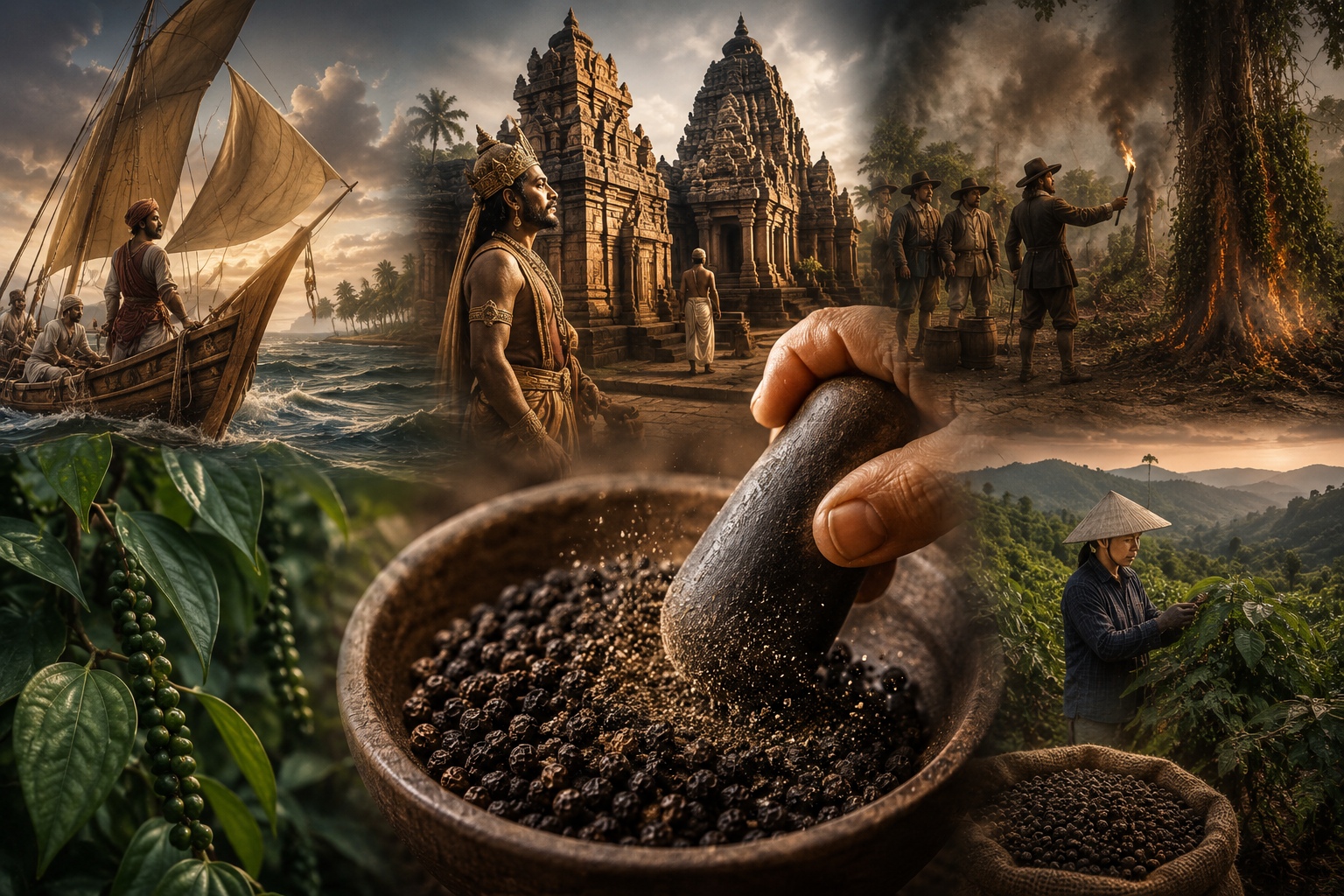
The history of spices is, at its core, the history of human desire for things that grow only elsewhere. It drove Indian sailors into unknown seas, embedded Hindu temples in Javanese hillsides and Sanskrit inscriptions in Vietnamese stone, funded genocides in the Banda Islands, and bankrolled the first age of European globalisation. Now, in the 21st century, the wheel has turned in the most unexpected direction.
India — the original kingdom of black pepper, the civilisation that gifted Piper nigrum to the ancient world, whose traders first planted it in Vietnamese Champa soil — now imports pepper from Vietnam to feed its own people. Kerala’s farmers, squeezed between degraded soils, climate change, and cheap Vietnamese imports flooding the market, are abandoning the vine for coffee and cardamom. The mother country of black pepper has been surpassed by its most distant pupil.
Vietnam’s triumph is a testament to what directed policy, market liberalisation, and farmer determination can accomplish in a single generation. From the ruins of war and the chaos of collectivisation, Vietnam found in a plant first introduced by ancient Indian traders the engine of an agricultural revolution that remade the global spice map.
The Maluku Islands — once the most coveted territory on earth, whose cloves and nutmeg funded European empires and whose people were massacred for a monopoly — now receive occasional heritage tourists wondering at the sites of history’s most expensive crimes.
Every pinch of black pepper you grind carries within it the entire weight of this history — Indian sailors on monsoon winds, Cham kings in Sanskrit temples, Dutch merchants burning trees, and Vietnamese farmers in the Central Highlands rewriting the rules of the ancient trade.
Conclusion
The story of black pepper, cloves, and nutmeg is far more than a tale of trade—it is a story of exploration, cultural exchange, empire, innovation, and resilience. From the lush forests of Kerala and the legendary Spice Islands of Indonesia to the fertile highlands of Vietnam, spices have influenced the rise and fall of kingdoms, inspired global exploration, and transformed economies across continents.
For centuries, India stood at the heart of the world’s spice network, connecting civilizations through maritime trade routes and spreading its cultural influence throughout Southeast Asia. The legacy of Indian merchants can still be seen in the temples of Java, the Sanskrit heritage of Champa, and the enduring cultural links that bind the region together.
Yet history is never static. Vietnam’s remarkable rise from a war-torn nation to the world’s leading pepper producer demonstrates how strategic reforms, agricultural innovation, and global market integration can reshape entire industries. What began as a crop introduced through ancient Indian trade networks ultimately became the foundation of Vietnam’s agricultural success story.
Today, every grain of pepper carries a legacy thousands of years in the making—a legacy of sailors navigating monsoon winds, merchants building international networks, civilizations exchanging ideas, and farmers adapting to changing times. The journey of these spices reminds us that global history is often written not only by kings and conquerors, but also by the humble crops that connected the world long before the modern age.